A Tribute to John Cage

A Tribute to John Cage

1976 · 29 min · ★ 6.0 · TV Movie, Documentary, Music

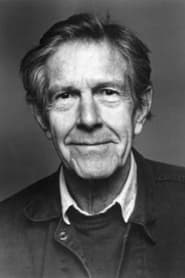
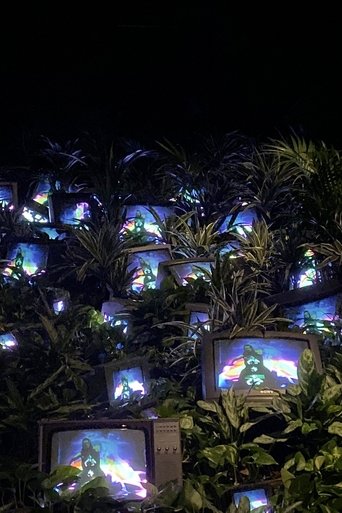
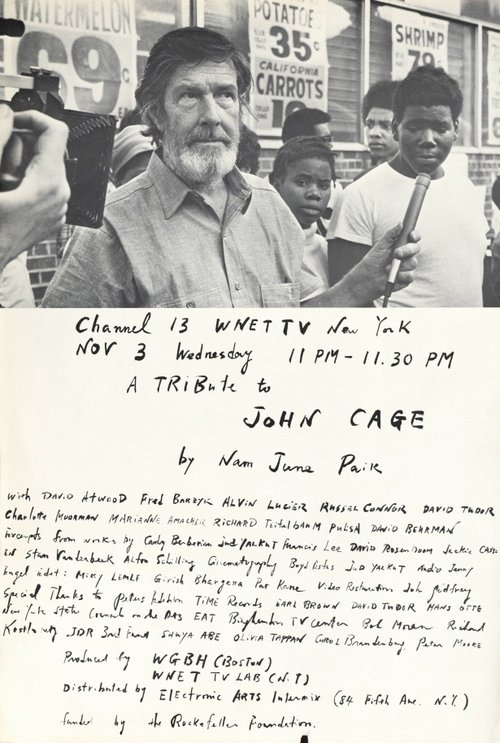
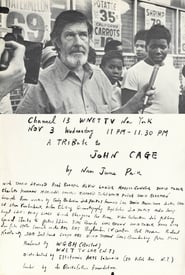
A Tribute to John Cage is Paik's homage to avant-garde composer John Cage. A major figure in contemporary art and music, Cage was one of the primary influences on Paik's work, as well as his friend and frequent collaborator. In this multifaceted portrait, Paik creates a pastiche of Cage's performances and anecdotes, interviews with friends and colleagues, and examples of Paik's participatory music and television works that parallel Cage's strategies and concerns. The methodology and philosophies that inform Cage's radical musical aesthetic — chance, randomness, the democratization of sounds — are evident as he performs such seminal pieces as 4'33" (of complete silence) in Harvard Square, or throws the I Ching to determine performance sites. Among the collage of elements included in this work are segments from Paik's Zen for TV; Paik and Charlotte Moorman in early performances, including the TV Bra; and anecdotes from composer Alvin Lucier.

Directed by Nam June Paik

Your Rating

Cast

Make it a double feature

4h 45m together
Both from Nam June Paik.

More from Nam June PaikSee all →
Good Morning, Mr. OrwellGood Morning, Mr. Orwell · 1984
Good Morning, Mr. Orwell
8.11984
MovieComedyMusic
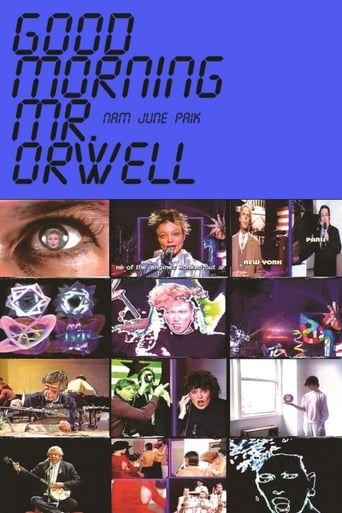
In his book "1984", George Orwell saw the television of the future as a control instrument in the hands of Big Brother. Right at the start of the much-anticipated Orwellian year, Paik and Co. were keen to demonstrate satellite TV's ability to serve positive ends-- Namely, the intercontinental exchange of culture, combining both highbrow and entertainment elements. A live broadcast shared between WNET TV in New York and the Centre Pompidou in Paris, linked up with broadcasters in Germany and South Korea, reached a worldwide audience of over 10 or even 25 million (including the later repeat transmissions).
Back to Fucking CambridgeBack to Fucking Cambridge · 1987
Back to Fucking Cambridge
8.01987
MovieComedy
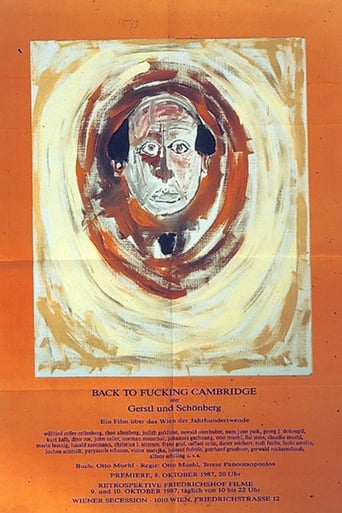
About a group of graduates from Cambridge University who go back to their college to visit a friend who has stayed on there. Otto Muehl founded a community of artists in Vienna in 1970 with the aim of exploring a completely free life practice. Since 1972, this society experiment at the Friedrichshof in Burgenland, 60 kilometers from Vienna, further developed. From the mid-1970s, other municipalities were founded in 30 European cities. At Friedrichshof itself lived at times up to 240 members and visitors.
Beatles ElectroniquesBeatles Electroniques · 1969
Beatles Electroniques
8.01969
MovieMusic
Part of a collection of restored early works by Nam June Paik, the haunting Beatles Electronique reveals Paik's engagement with manipulation of pop icons and electronic images. Snippets of footage from A Hard Day's Night are countered with Paik's early electronic processing.
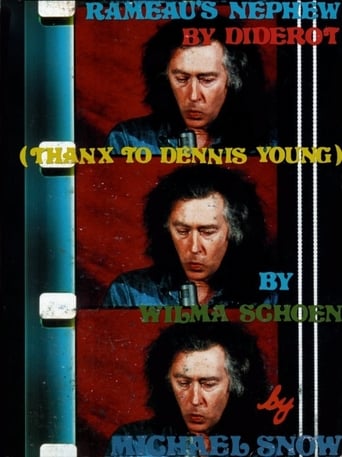
‘Rameau’s Nephew’ by Diderot (Thanx to Dennis Young) by Wilma Schoen‘Rameau’s Nephew’ by Diderot (Thanx to Dennis Young) by Wilma Schoen · 1974
‘Rameau’s Nephew’ by Diderot (Thanx to Dennis Young) by Wilma Schoen
7.81974
MovieComedyMystery
Various unrelated vignettes, often juxtaposing sound and image.
Global GrooveGlobal Groove · 1973
Global Groove
7.71973
MovieMusicTV Movie
Global Groove was a collaborative piece by Nam June Paik and John Godfrey. Paik, amongst other artists who shared the same vision in the 1960s, saw the potential in the television beyond it being a one-sided medium to present programs and commercials. Instead, he saw it more as a place to facilitate a free flow of information exchange. He wanted to strip away the limitations from copyright system and network restrictions and bring in a new TV culture where information could be accessed inexpensively and conveniently. The full length of the piece ran 28 minutes and was first broadcasted in January 30, 1974 on WNET.
Merce by Merce by PaikMerce by Merce by Paik · 1978
Merce by Merce by Paik
6.51978
Movie
Merce by Merce by Paik is a two-part tribute to choreographer Merce Cunningham and artist Marcel Duchamp. The first section, “Blue Studio: Five Segments”, is a work of video-dance produced by Merce Cunningham and videomaker Charles Atlas. The second part, produced by Paik and Shigeko Kubota, further queries the relationship between everyday gestures and formal notions of dance.
All Star VideoAll Star Video · 1985
All Star Video
6.51985
MovieAnimationDocumentary
A compilation of avant-garde artwork and talent of the mid to late 20th century hosted by Ryuichi Sakamoto.
Adelic PenguinsAdelic Penguins · 1986
Adelic Penguins
1986
MovieMusic
Originally commissioned by the Sony Corporation of Japan and performed live on the JumboTRON, a fourteen-story TV set at the Expo in Tsukuba, Japan, Adelic Penguins is a collaboration between Fitzgerald, artist Paul Garrin, and composer Ryuichi Sakamoto (who also appears as a performer). Structured in six segments, this technical tour-de-force is a pyrotechnic fusion of sound and image, in which the dynamic visual imagery fully complements and heightens Sakamoto's staccato, percussive score. Fitzgerald and Garrin merge terrestrial and interplanetary worlds, in which Sakamoto's figure becomes an integral part of the landscape. Set aloft in the surreal world of the artists' invention, Sakamoto dances, floats and walks through a hyperkinetic universe.
Sistine ChapelSistine Chapel · 1993
Sistine Chapel
1993
MovieDocumentaryHistory
Sistine Chapel is an audio-visual collage of new footage and samples from Paik’s past videos, which featured many of his friends, collaborators, and public figures. It was Paik’s own way of summarizing his artistic career with video. The film installation consists of fast-paced and overlapping images that completely cover the gallery walls and ceiling—one of the most under-appreciated parts of architecture, according to Paik. With its electronic visuals and booming audio, interspersed with periods of silence, the immersive installation stands in stark contrast to the experience of its namesake.
Video: The New WaveVideo: The New Wave · 1975
Video: The New Wave
1975
MovieDocumentary
The New Wave is the seminal compendium of independent video work in the early 1970s. Written and narrated by Brian O'Doherty, this overview of the emerging video field includes examples of guerrilla television and "street" documentaries, early explorations with image-processing and synthesis, and performance video. This historical anthology includes excerpts of tapes by the following video pioneers: Stephen Beck and Warner Jepson, Peter Campus, Douglas Davis, Ed Emshwiller, Bill Etra, Frank Gillette, Don Hallock, Joan Jonas, Richard Serra, Paul Kos, Nam June Paik, Otto Piene, Willard Rosenquist, Dan Sandin, James Seawright, Steina Vasulka, TVTV, Stan Vanderbeek and William Wegman.
TapesTapes · 2020
Tapes
2020
MovieDocumentary
The tapes in the program consist of some of Mekas’ earliest cassettes from the 1990s not long after he first began working with video as well as more recent mini-DV tapes from 2010s. The contents of the tapes have not been previously seen in their entirety. The footage provides rare insight into aspects of Mekas’ video-making practice, as well as his activities, thoughts, dreams, and concerns, especially during the later years of his life.
Home Movies 1971-81Home Movies 1971-81 · 1985
Home Movies 1971-81
1985
MovieDocumentary
Home movies shot on Super 8mm by W+B Hein over 10 years.
Re: Maciunas and FluxusRe: Maciunas and Fluxus · 2011
Re: Maciunas and Fluxus
2011
MovieDocumentary
“Drawing on his personal archives, Mekas has assembled a Fluxus vaudeville starring Yoko Ono, Joseph Beuys, and the late Nam June Paik. Most of the material is relatively recent although Ben Vautieur shows some early 1960s work to hilarious effect and Mekas channels Fluxus founder George Maciunas throughout.” – J. Hoberman, VILLAGE VOICE
The Medium Is the MediumThe Medium Is the Medium · 1969
The Medium Is the Medium
1969
MovieTV Movie
Produced by WGBH-TV in Boston, the Medium Is the Medium is one of the earliest and most prescient examples of the collaboration between public television and the emerging field of video art in the U.S. WGBH commissioned artists — Allan Kaprow, Nam June Paik, Otto Piene, James Seawright, Thomas Tadlock and Aldo Tambellini — to create original works for broadcast television. Their works explored the parameters of the new medium, from image processing and interactivity to video dance and sculpture.
Allan ‘n Allen’s ComplaintAllan ‘n Allen’s Complaint · 1982
Allan ‘n Allen’s Complaint
1982
Movie
The influence of Jewish fathers on their sons and the complexity of familial relationships are explored in a witty, poignant portrait of two artists. Beat poet Allen Ginsberg (whose father Louis was a poet in his own right) and performance artist/sculptor Allan Kaprow (whose father is a high-powered lawyer) are the sons who struggle with and against the influences of these patriarchal figures.
Fluxfilm Anthology 1962-1970Fluxfilm Anthology 1962-1970 · 2010
Fluxfilm Anthology 1962-1970
2010
MovieDocumentaryFantasy
Feature-length compilation program presenting 37 out of 41 original fluxfilms produced and directed in the 1960s by Fluxus artists, including George Maciunas, Nam June Paik, Yoko Ono, Robert Watts, Paul Sharits, et al.

More Like This

Couldn't load this row right now.
Rate this film

Your ratings make Midnight smarter