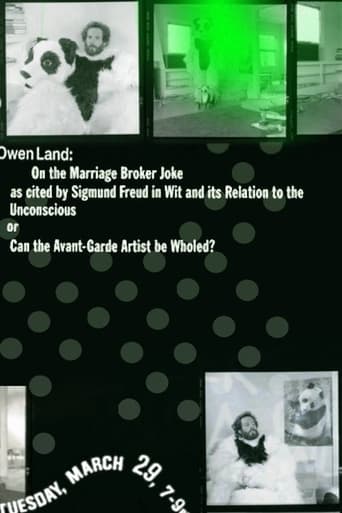
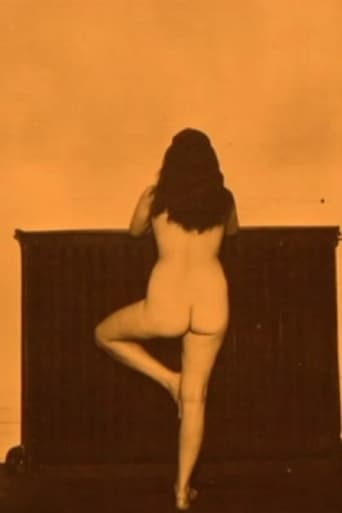
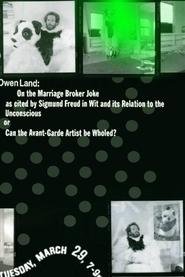
On the Marriage Broker Joke as Cited by Sigmund Freud in Wit and Its Relation to the Unconscious, or Can the Avant-Garde Artist Be Wholed?

On the Marriage Broker Joke as Cited by Sigmund Freud in Wit and Its Relation to the Unconscious, or Can the Avant-Garde Artist Be Wholed?

1977 · 18 min · ★ 5.1

“Freud established that jokes were structurally akin to dreams in their use of condensation, displacement, representation by opposites, punning and ‘nonsense’. All of these strategies are much in evidence in (Land’s) marvelously duplicitous ON THE MARRIAGE BROKER JOKE… [...] so clever and original a filmmaker as to make most others – not to mention his critics – seem flat-footed by comparison. ON THE MARRIAGE BROKER JOKE harks back to Bunuel’s early work. Not only is it structured like a dream and filled with sexual imagery, but like Un Chien Andalou, it smacks of being an insider’s joke played upon the avant-garde. Where Bunuel used the insights of psychoanalysis to satirize Christianity, Land– with an almost equal perversity – reverses the process and uses Christianity to send up Freud.” – J. Hoberman, American Film

Directed by Owen Land

Your Rating

Cast

Make it a double feature

36m together

On the Marriage Broker Joke as Cited by Sigmund Freud in Wit and Its Relation to the Unconscious, or Can the Avant-Garde Artist Be Wholed?

On the Marriage Broker Joke as Cited by Owen Land...in the Film 'On the Marriage Broker Joke as Cited by Sigmund Freud in Wit and Its Relation to the Unconscious, or Can the Avant-Garde Artist Be Wholed?'

Both from Owen Land.

More from Owen LandSee all →

On the Marriage Broker Joke as Cited by Owen Land...in the Film 'On the Marriage Broker Joke as Cited by Sigmund Freud in Wit and Its Relation to the Unconscious, or Can the Avant-Garde Artist Be Wholed?'On the Marriage Broker Joke as Cited by Owen Land...in the Film 'On the Marriage Broker Joke as Cited by Sigmund Freud in Wit and Its Relation to the Unconscious, or Can the Avant-Garde Artist Be Wholed?' · 2009
On the Marriage Broker Joke as Cited by Owen Land...in the Film 'On the Marriage Broker Joke as Cited by Sigmund Freud in Wit and Its Relation to the Unconscious, or Can the Avant-Garde Artist Be Wholed?'
10.02009
Movie
The Land Camera Collective presents a (nearly) shot-by-shot remake of the Owen Land 1977 classic experimental film 'On The Marriage Broker Joke as Cited by Sigmund Freud in Wit and Its Relation to the Unconscious, or Can the Avant-Garde Artist be Wholed?'
What's Wrong with This Picture? 2What's Wrong with This Picture? 2 · 1972
What's Wrong with This Picture? 2
9.01972
Movie
As Landow and his students were testing a new video camera, an elderly man began to talk to them about new technology. This impromptu conversation forms the basis for a comparison of spoken and written language. - Harvard Film Archive
Grand Opera: An Historical RomanceGrand Opera: An Historical Romance · 1979
Grand Opera: An Historical Romance
7.51979
MovieDocumentary
Grand Opera marks a stock-taking of Benning's work and his life, presenting a personal and artistic autobiography woven together with a series of events dealing with the historical development of the number pi, Benning's travels, and homages to Michael Snow, Hollis Frampton, George Landow (Owen Land), and Yvonne Rainer.
What's Wrong with This Picture? 1What's Wrong with This Picture? 1 · 1971
What's Wrong with This Picture? 1
7.01971
Movie
A found, utilitarian object, the overtly moralizing educational film “How to be a Good Citizen,” is elevated to the status of ‘art’. First presented unaltered and then in Landow’s color facsimile, the film is further modified by applying an opaque matte that creates a spatial paradox. - Harvard Film Archive
New Improved Institutional Quality: In the Environment of Liquids and Nasals a Parasitic Vowel Sometimes DevelopsNew Improved Institutional Quality: In the Environment of Liquids and Nasals a Parasitic Vowel Sometimes Develops · 1976
New Improved Institutional Quality: In the Environment of Liquids and Nasals a Parasitic Vowel Sometimes Develops
6.31976
Movie
A reworking of an earlier film, Institutional Quality, in which the same test was given. In the earlier film, the person taking the test was not seen, and the film viewer in effect became the test taker. The newer version concerns itself with the effects of the test on the test taker. An attempt is made to escape from the oppressive environment of the test — a test containing meaningless, contradictory, and impossible-to-follow directions by entering into the imagination. —Canyon Cinema
DiploteratologyDiploteratology · 1978
Diploteratology
6.01978
Movie
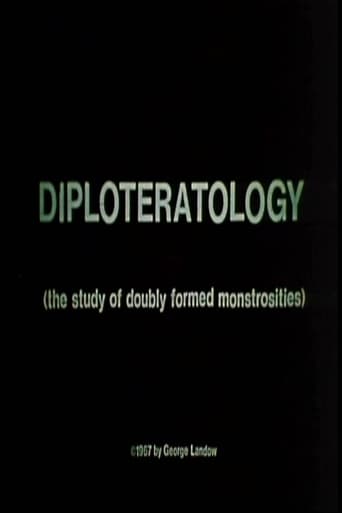
A revision of Bardo Follies, Diploteratology suggests that “death (destruction of the original image) is not an end but merely the next stage.” Preceded by longer versions entitled "Bardo Follies."
The Evil FaerieThe Evil Faerie · 1966
The Evil Faerie
5.21966
Movie
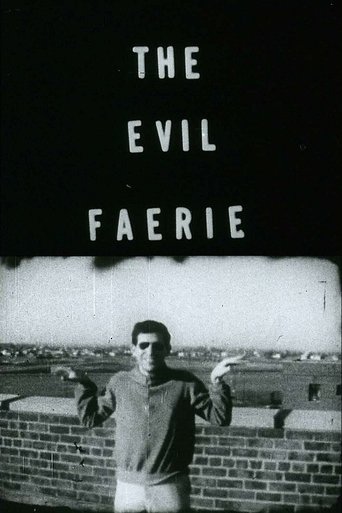
Following a series of title cards, a man in sunglasses briefly flutters his hands like fairy. Owen Land states that this film was not made by George Landow, and believes it should be credited to John Cavanaugh. "George Maciunas had a number of films which didn’t have titles on them. Then he put them together into his Fluxus reel and tried to remember who made them. It was an intentional Fluxus joke." (Owen Land, interview with Mark Webber, 2004)
Bardo FolliesBardo Follies · 1967
Bardo Follies
5.11967
Movie
A shot of a Southern Belle waving to a group of tourists on a pleasure boat ride is looped, multiplied and then melted, creating psychedelic abstract images. “A paraphrasing of certain sections of the Tibetan Book of the Dead in motion picture terms.” - Harvard Film Archive. Originally ran 45 minutes, then was edited down to 30, then 20 minutes. Final version was simply entitled "Diploteratology" and runs 7 minutes, and is the most commonly shown version.
The Film That Rises to the Surface of Clarified ButterThe Film That Rises to the Surface of Clarified Butter · 1968
The Film That Rises to the Surface of Clarified Butter
5.11968
MovieAnimation
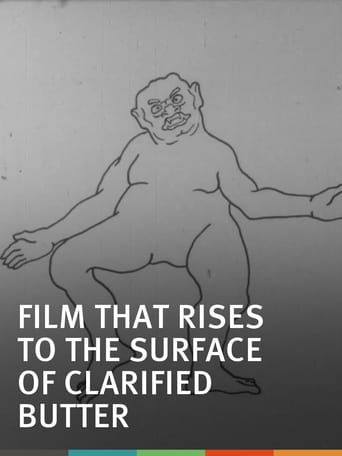
Two artists create grotesque characters; Two-dimensional drawings which somehow have a life of their own, that exist in the same space as real objects. The film seems to ask, "Isn't every filmmaking venture a series of repeated, once-negative images displayed alongside the real world?"
Thank You Jesus for the Eternal PresentThank You Jesus for the Eternal Present · 1973
Thank You Jesus for the Eternal Present
4.51973
Movie
A rapturous audio-visual mix that “deliberately seeks a hidden order in randomness.” The film combines the face of a woman in ecstatic, contemplative prayer with shots of an animal rights activist, and a scantily clad model advertising Russian cars at the International Auto Show, New York. - Harvard Film Archive
Film in Which There Appear Edge Lettering, Sprocket Holes, Dirt Particles, Etc.Film in Which There Appear Edge Lettering, Sprocket Holes, Dirt Particles, Etc. · 1966
Film in Which There Appear Edge Lettering, Sprocket Holes, Dirt Particles, Etc.
4.51966
Movie
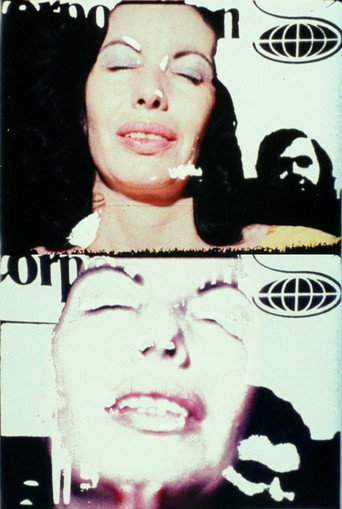
Film in Which There Appear... is a six-minute loop of the double-printed image of a "China girl" or "Shirley card", her image off-center, making visible the sprocket holes and edge lettering on the film. According to Land, within the loop, "no development in the dramatic or musical sense" occurs. Fred Camper described Film in Which There Appear... as "a kind of Duchampian found object, a [...] film that focuses attention on the medium and the viewer." There also exists a 20-minute "widescreen version" involving two prints of the film projected side-by-side, with the left print flipped horizontally so that the "China girl" forms an almost complete face in the center.
Remedial Reading ComprehensionRemedial Reading Comprehension · 1970
Remedial Reading Comprehension
4.31970
Movie
Landow rejects the dream imagery of the historical trance film for the self-referential present, using macrobiotics, the language of advertising, and a speed-reading test on the definition of hokum. The alienated filmmaker appears, running uphill to distance himself from the lyrical cinema, but remember, "This is a film about you, not about its maker."
Wide Angle SaxonWide Angle Saxon · 1975
Wide Angle Saxon
4.21975
Movie
An interpretation of The Confessions of Saint Augustine featuring an ordinary middle-aged man who undergoes a conversion experience whilst watching an experimental film. - Harvard Film Archive
A Film of Their 1973 Spring Tour Commissioned by Christian World Liberation Front of Berkeley, CaliforniaA Film of Their 1973 Spring Tour Commissioned by Christian World Liberation Front of Berkeley, California · 1974
A Film of Their 1973 Spring Tour Commissioned by Christian World Liberation Front of Berkeley, California
3.01974
MovieDocumentary
A radical Christian group's lecture tour of US colleges was filmed in the cinema verité tradition, with hand held camera, sync and wild sound. To avoid making a conventional documentary, the filmmaker created a dynamic collage by stroboscopically editing together pairs of scenes using a rapid rhythm of three-frame units.
Fluxfilm Anthology 1962-1970Fluxfilm Anthology 1962-1970 · 2010
Fluxfilm Anthology 1962-1970
2010
MovieDocumentaryFantasy
Feature-length compilation program presenting 37 out of 41 original fluxfilms produced and directed in the 1960s by Fluxus artists, including George Maciunas, Nam June Paik, Yoko Ono, Robert Watts, Paul Sharits, et al.
Dialogues, or A Waist Is a Terrible Thing to MindDialogues, or A Waist Is a Terrible Thing to Mind · 2009
Dialogues, or A Waist Is a Terrible Thing to Mind
2009
Movie
Dialogues is Land's last film: A chaotic, self-reflexive experimental narrative about many, many things-- namely Land himself. A caustic, anything-goes attitude permeates the late work.

More Like This

Couldn't load this row right now.
Rate this film

Your ratings make Midnight smarter