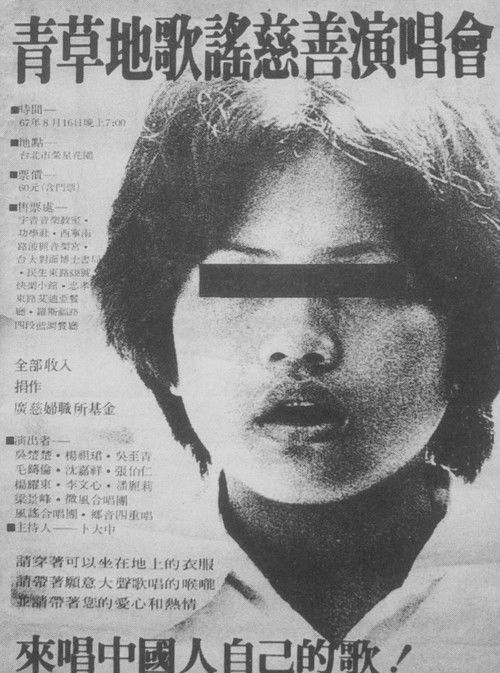
Yang Tsu-chuen and the Green Field Charity Concert

Yang Tsu-chuen and the Green Field Charity Concert

1978 · 21 min · Documentary, Music

Documenting Taiwan’s first large-scale postwar outdoor concert, this film revisits the 1978 Grass Field Charity Concert, an unprecedented gathering of over 4,000 people. Organized by singer and television host Yang Tsu-Chun (楊祖珺) during the height of the island’s folk song movement, the event foregrounded music’s relationship with everyday life rather than overt political messaging. Yet its significance was inseparable from the era’s tensions: Yang’s self-titled album had recently been banned for the perceived “left-wing” social consciousness of her lyrics, and despite the concert’s stated charitable intent, its scale and popular appeal drew the scrutiny of Kuomintang (KMT) intelligence agencies. Framed against late-1970s Taiwan, the film documents how music, public space, and cultural expression intersected under authoritarian surveillance, marking a pivotal moment in the history of popular music and collective gathering.

Directed by Chang Chao-Tang

Your Rating

Cast

More from Chang Chao-TangSee all →

China BehindChina Behind · 1978
China Behind
6.21978
MovieDrama
A group of Mainlanders fleeing the Cultural Revolution risk all to reach the adjacent British ‘haven’ of Hong Kong; yet what they find there is a far cry from their dreams of liberty.
Experiment 002Experiment 002 · 1994
Experiment 002
1994
Movie
In 1994 HUANG Hua-cheng showed his 8mm film Experiment 002 during a seminar titled ‘Theater Quarterly and Me’ at the Chinese Taipei Film Archive. This film is a recording of the seminar, documenting how the film was played and the seminar proceedings. HUANG passed away in 1996, and his earlier films have been lost.
Songs of Pasta'aySongs of Pasta'ay · 1989
Songs of Pasta'ay
1989
MovieDocumentary
The Pasta’ay, which means "the festival of the legendary little people," is a significant ritual held every other year in the Saisiat aborigine group in Taiwan. Every ten years, they hold the Great Ritual. This film focuses on the Great Ritual in 1986. It tries to convey the Saisiat people’s affection for and belief in the legendary little people. At the same time, the film brings into light Saisiat people’s ambivalence towards tourist invasion, and their dilemma of being caught between tradition and modernization. Structured by the Pasta’ay songs’ movements, the film breaks down to 15 chapters. It carefully juxtaposes the visual with the aural elements, which are conveyed in the conceptual dichotomy between “the real” and “the artificial.”
Modern Poetry Exhibition/1966Modern Poetry Exhibition/1966 · 1966
Modern Poetry Exhibition/1966
1966
Movie
Artists contributing to the 1966 Modern Poetry Exhibition included HUANG Hua-cheng, LONG Sih-liang, HUANG Yong-song, and CHANG Chao-tang; each artist chose their favorite modern poems and transformed them into imagery. This film is a time capsule capturing some of the exhibits, as well as the young artists.
逆旅與幻象逆旅與幻象 · 1984
逆旅與幻象
1984
MovieDocumentary
Early collaboration between Chang Chan-tang and Christopher Doyle documenting the friendship of their inner circle in Taiwan during the early 80s.
The Instant of Gaze: Portraits by Chang Chao-TangThe Instant of Gaze: Portraits by Chang Chao-Tang · 1999
The Instant of Gaze: Portraits by Chang Chao-Tang
1999
Movie
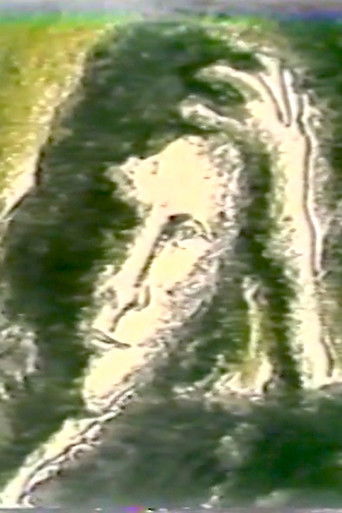
A biographical documentary filmed in 1999 on the occasion of Chang Chao-tang (張照堂) receiving the National Award for Arts (國家文藝獎) in the Fine Arts category (美術類). In the film he is credited as both director and editor under the pseudonym “Gao Shang-tu” (高尚土)—a name derived by decomposing the character “tang” (堂) into its constituent elements “gao” (高), “shang” (尚), and “tu” (土). Semantically, the pseudonym implies a counter-reference to the notion of temple-like, institutional “high culture,” redirecting emphasis instead toward the vernacular and the earthy—suggesting that what is truly “noble” lies in the force emerging from the “soil” (土) of the people. For this reason, the film may also be understood as a semi-autobiographical documentary that carries an element of self-writing within its particular historical context.
Journey into the MineJourney into the Mine · 1981
Journey into the Mine
1981
MovieDocumentary
“Journey into the Mine” (礦之旅) is a 1981 documentary directed by Chang Chao-Tang (張照堂). Part of the “Journey Through Images” series (映象之旅), it documents the Ruìsān Coal Mine (瑞三煤礦) in Houtong, Ruifang (瑞芳侯硐). Using a portable ENG camera, the crew descended 600 meters underground to record miners working amid heat, coal dust, and gas hazards. Rejecting elite-centered television perspectives, the film foregrounds the resilience of working-class laborers. Its essayistic voice-over is paired with ECM jazz and blues, creating a distinctive tone. In 1982, it won the Golden Bell Award (金鐘獎) for Best Educational and Cultural Program. A rebroadcast added footage of the Neihu Futian Coal Mine disaster (內湖福田煤礦災變), producing a stark dialogue between policy narrative and industrial tragedy. Its footage was later used in Hou Hsiao-hsien’s 1986 film Dust in the Wind”(戀戀風塵).
V-10「女展」剪影V-10「女展」剪影 · 1971
V-10「女展」剪影
1971
MovieDocumentary
A short documentary directed by Chang Chao-Tang (張照堂) while working as a cameraman at China Television Company (中國電視公司), produced for the television program News Highlights (新聞集錦). The film documents the group exhibition “Womangraphy” (「女展」), organized by V-10 (Group Visual-10).
Regarding Huang Hua-ChengRegarding Huang Hua-Cheng · 2020
Regarding Huang Hua-Cheng
2020
MovieDocumentary
An in-depth documentary on the reclusive Taiwanese artist Huang Hua-Cheng and his avant-garde legacy. Commissioned by the Taipei Fine Arts Museum for the retrospective exhibition: “An Open Ending: Huang Hua-Cheng” (2020).
Journey through ImagesJourney through Images · 1981
Journey through Images
1981
MovieDocumentary
This landmark 1981–82 documentary series consists of weekly 25-minute episodes filmed across Taiwan using an ENG (Electronic News Gathering) camera. It documents local customs and social textures through a distinctly humanistic lens. The project also marks an early collaboration between Christopher Doyle and Chang Chao-Tang.
The Homecoming Pilgrimage of Dajia MazuThe Homecoming Pilgrimage of Dajia Mazu · 1975
The Homecoming Pilgrimage of Dajia Mazu
1975
MovieDocumentary
Viewers are transported back in time to 1974 to see the annual Taoist celebration of the Dajia Mazu Pilgrimage. Thousands of participants accompany a statue of the goddess Mazu, who protects seafarers, on a 9-day, 8-night procession, stopping at several prominent temples along the way. The religious pilgrimage is a round-way journey from the Zhenlan Temple in Dajia, Taichung City to Fengtian Temple in Xingang of Chiayi County on the Western plains of Taiwan. The mesmerising festival takes place every year during the third lunar month and still attracts large masses to this day. The audio track of the film was once banned under the Kuomintang (KMT) due to the film’s inclusion of spoken Hokkien (Taiwanese), giving viewers at the time an altered and suppressed understanding of the event and its cultural significance in Taiwan. Viewers now can revel in the beauty of the Taiwanese language and see the film for the true spirit that it captures.
Carving, Lin YuanCarving, Lin Yuan · 2003
Carving, Lin Yuan
2003
MovieDocumentary
Documenting outsider artist Lin Yuan (林淵, 1913-1992), a self-taught folk artist from Nantou (南投), and his stone sculptures—works marked by simplicity, naturalness, and a vital rural vernacular spirit.
The Dragon Boat FestivalThe Dragon Boat Festival · 1975
The Dragon Boat Festival
1975
MovieDocumentary
The riverbanks are dotted with food stalls and buzzing with the parasol-holding crowd. Everyone is here to watch the exciting dragon boat race. Voice-over narration in melodic Taiwanese describes pre-festival preparation, and the celebrations and rituals in various parts of Taiwan. Through carefully-crafted script and well-executed camerawork, this documentary gives a vibrant portrait of ordinary people’s lives in a festive atmosphere.
The Beauty of RitualsThe Beauty of Rituals · 1981
The Beauty of Rituals
1981
MovieDocumentary
"The Beauty of Rituals" (《祭典之美》) by Chang Chao-tang (張照堂) surveys Taiwanese folk festivals across regions and seasons, framing them through the perspectives of archaeologist Chen Chi-lu (陳奇祿), choreographer Lin Hwai-min (林懷民), psychologist Yu Te-hui (余德慧), and painter Shiy De-jinn (席德進). The script and voiceover by Chiang Hsun (蔣勳) articulate the symbolic and affective dimensions of traditional belief.With music by Ma Shui-long (馬水龍), Chou Wen-chung (周文中), Kitaro (喜多郎), and Mike Oldfield, the film juxtaposes Eastern and Western sonic forms, re-mediating ritual as a dynamic contemporary cultural field.
Wild CursiveWild Cursive · 2009
Wild Cursive
2009
MovieMusic
"Wild Cursive" is the third piece of Taiwanese dancer and choreographer Lin Hwai-min's Cursive trilogy, a captivating series translating the development of the fascinating art form of Chinese calligraphy into dance. As Lin says himself, the final part marks the climax of the trilogy, because it corresponds to the completely detached, free and highly abstract forms of “spontaneous” calligraphy. The performance contains elements of Tai Chi and is musically accompanied by compositions by Jim Shum and Liang Chun-mei. The performance was recorded in 2009 at the National Theater in Taipei, Taiwan.
Old HouseOld House · 1980
Old House
1980
MovieDocumentary
The Chen Family Residence “Chen Sì-yù” in Xiushui Township, Changhua, was built in 1846 (the 26th year of the Daoguang reign, Qing dynasty). Designed by craftsmen from Tangshan and constructed using stone from Mount Wuyi, the residence features a symmetrical and meticulously crafted layout. The “Wénkuí” plaque above the main entrance serves as a moral exhortation to future generations, bearing witness to the Chen ancestors’ journey across the strait from Fujian to Taiwan.

More Like This

Couldn't load this row right now.
Rate this film

Your ratings make Midnight smarter