Directing
Takahiko Iimura
Born February 20, 1937 · Tokyo, Japan (age 89)
Takahiko Iimura has been a pioneer artist of Japanese experimental film and video, working with film since l960 and with video since 1970 while residing in New York and Tokyo. He is a widely established international artist, having numerous solo exhibitions in major museums such as the Museum of Modern Art, New York, the Whitney Museum, New York, Anthology Film Archives, New York, Centre George Po…
Known For
 Home Movies 1971-81 · 1985
Home Movies 1971-81
1985
MovieDocumentary
Home movies shot on Super 8mm by W+B Hein over 10 years.
 Yoko Ono: This Is Not Here · 1972
Yoko Ono: This Is Not Here
★ 6.01972
MovieDocumentary
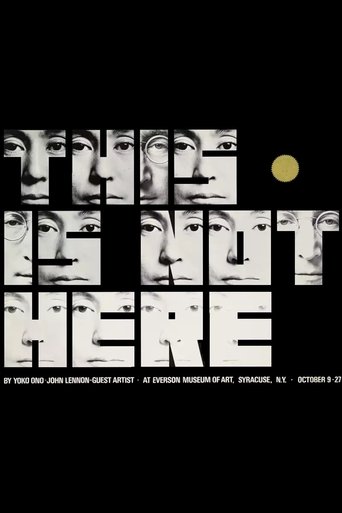
On John's 31st birthday, Yoko held an art exhibit, "This Is Not Here", at the Everson Museum of Art in Syracuse, N.Y.. The show was taped and aired on U.S. TV on May 11, 1972 as "John and Yoko in Syracuse, New York.
 Desade · 1963
Desade
1963
Movie
From the collector of Marquis de Sade in the early 1960s, still a 'dark age ' of erotic picture, even his novels were forbidden to publish in Tokyo, I burrowed the copies of the engraving taken from the 18th century edition of "The story of Juliette" and of "The story of Justine." and rearranged along a story made from of the pictures not from the novels. An exercise out of the curiosity. It was the same year I made Ai (Love) in 1962 which consists of mostly extreme close-ups of love making. I have kept DeSade for many years in my closet without looking at it myself and have forgotten about it. By a chance I re-found the film 50 years later that there is something worth to see. (T.I, 2012)
 The Masseurs · 1963
The Masseurs
1963
MovieDocumentary
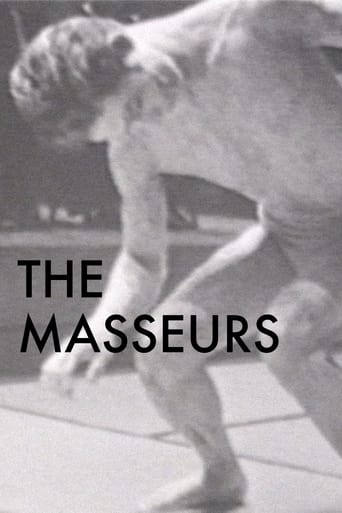
Anma (The Masseurs) is a representative and historical work by the creator of Butoh dance, Tatsumi Hijikata in his early period in the 1960s. The film is realized not only as a dance document but also as a Cine-Dance, a term made by Iimura, that is meant to be a choreography of film. The filmmaker "performed" with a camera on the stage in front of the audience. With the main performers: Tatsumi Hijikata and Kazuo Ohno, the film has the highlights such as Butohs of a soldier by Hijikata & a mad woman by Ohno. There is a story of the mad woman, first outcast and ignored, at the end joins to the community through her dance. Inserted descriptions of Anma (The Masseurs) are made for the film by the filmmaker, but were not in the original Butoh. The film, the only document taken of the performance, must be seen for the understanding of Hijikata Butoh and the foundation of Butoh.
 Love · 1962
Love
★ 8.01962
Movie
"10 minutes of the act of creation itself run through close up and magnifying lenses. " -T.I.
 Junk · 1962
Junk
1962
Movie
"It's a mixture of [dead] animals, pieces of [broken] furniture, industrial waste, kids playing. I didn't have in mind any of the kind of historical perspective, nor was I trying to make an ecological statement. I was showing the new landscape of our civilization. My point of view was animistic. I tried to revive those dead animals metaphorically and to give the junk new life."
 Circle & Square · 1981
Circle & Square
1981
Movie
The 1981 performance Circle & Square by Takahiko Iimura, New York-based Japanese film and video pioneer, evolved from the artist's interest in exposing the apparatus of projection and the materiality of image and light, which began in the mid-60s. The work commences with the projection of a long loop of black 16mm film leader suspended from the ceiling. The artist punches a hole on the film's surface and as it loops through the projector's gate, a single white circle of light pierces the darkness. With each subsequent punch the film builds before the viewer’s eyes into a cascade of white circles before reaching its abrupt and revelatory conclusion.
 Four Shadows · 1978
Four Shadows
★ 7.01978
Movie
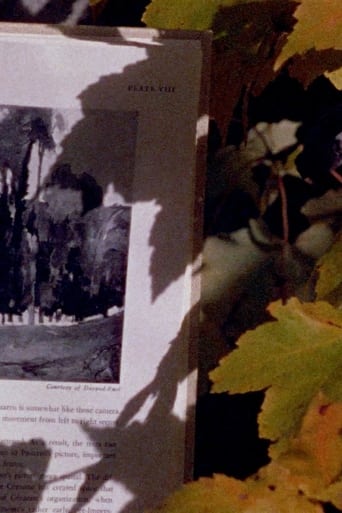
Four four-minute image sections and four four-minute sound sections are linked in all combinations of the sound sections with each of the image sections. This established affinities between each of the image sections to the others, and the sound sections to each other. The image sections are: surveyors measuring the land near my house as seen through an old window, a family of Siamang Gibbon apes in the Washington zoo, an industrial site, and a page turned from a book on Cézanne’s composition showing a diagram of his painting Mardi Gras, filmed against bright leaves. The sound sections are: a dramatic scene from Debussy’s opera “Pelléas et Mélisande”, a passage from William Wordworth’s autobiographical poem “The Prelude,” sounds from rowing on a lake at night, and the sounds of the apes vocalizing.