Goats & Sheep
2001 · 12 min
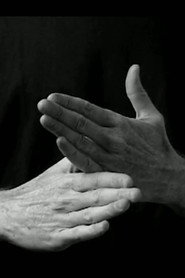
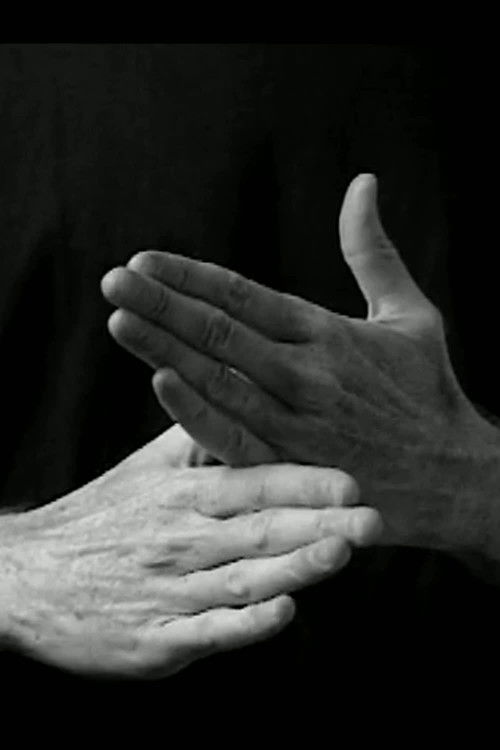
Goats and Sheep uses the source material of the installation Withershins, 1995, consisting of two simultaneous views of a person signing: the hands and arms are framed in one, and the back of the head and top of the shoulders in the other. This latter view catches the hands when they refer to the head during signing. For Goats and Sheep, Hill changed the color image into black-and-white, re-recorded his own voice and “re-synchronized” it to the original signing. The stereo field is used to double the voice with about a second of delay added to the sound. This doubling mirrors the hands and numerous references and repetitions heard in the text.
Directed by Gary Hill
Your Rating
More from Gary HillSee all →
 Tale Enclosure · 1985
Tale Enclosure
★ 8.01985
Movie
Returning to the primal source of language, Hill explores the physical and subconscious origins of speech. In a continuous shot of a rhythmic, linguistically inspired chant-performance by George Quasha and George Stein, the camera wanders from mouth to face to hands to figure in an open-ended visual search. The performers use the body as an acoustic instrument of sound and abstract utterances.
 Videograms · 1981
Videograms
★ 8.01981
Movie
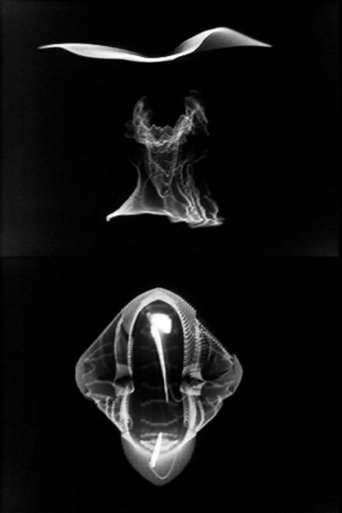
1980-81, 13:27 min, b&w, sound Videograms is an ongoing series of text/image constructs or syntaxes using the Rutt/Etra Scan Processor, a device that enables Hill to sculpt electronic forms on the screen. Each "videogram" relates literally or conceptually to Hill's accompanying spoken text, which is visually translated into abstract shapes. Hill writes, "The vocabulary and precision of this tool allowed me to expand the notion of an 'electronic linguistic' through textual narrative blocks created specifically for the electronic vocabulary inherent in the Rutt/Etra device."
 Skaterdater · 1965
Skaterdater
★ 6.31965
MovieRomanceDrama
The film tells a story with no dialogue. The group of boy skaters are suddenly at a point when one of the boys sees a young girl, and becomes interested in her. This causes a rift with the other boys, who challenges him to a skating duel that goes down a hilly street. The young boy loses. However, he gets the girl, and shortly, a few other girls are seen and become interested in the boys, too. The film was nominated for an Oscar for Best Live Action Short Film. Preserved by the Academy Film Archive in 2010.
 Earth Pulse · 1975
Earth Pulse
1975
Movie
A humanoid form strikes its body while making primal guttural sounds. At times the form is “stopped” and “started” using the pause of a reel-to-reel video player—a frozen line of noise (an asynchronous frame) cuts through the image reinforcing the sense of physicality. The sounding form is eventually set in an electronically generated landscape with temple-like forms of undulating feedback. Further processing of the voice and additional rhythmic electronic sounds are suggestive of ritual.
 Picture Story · 1979
Picture Story
1979
Movie
“A structural work (with humor) that uses indeterminacy to forge an abstract landscape upon which the ‘vision’ of an ox appears. A sequence of words—hierarchically ordered from the utilitarian (functions and processes of the tools being used to make the piece) to the more abstract and conceptual, ‘content,’ ‘concept,’ and ‘vision’—become the building blocks of a linguistic picture story.”
 Soundings · 1979
Soundings
1979
Movie
Two color video cameras, two microphones, Dave Jones prototype modules (input amplifiers, variable soft/hard keyers, output amplifier, analog-to-digital converter, bit switch, digital-to-analog converter), assorted speaker cones, enclosed speaker, sand, large spike nails, lighter fluid, lighter, amplifier, wire, and water.
 Commentary · 1980
Commentary
1980
Movie
“Made just before Around & About, this work is something of a ‘manifesto in jest’ against television…. I’m a sit-in viewer looking slightly up at the screen making simple gestures into the camera. The mood is ambiguous as I seem to be watching a mirror, covering my face, reaching out to the camera, obstructing my head with a harsh (interrogator’s) lamp, and maybe more. The image, distorted through a fisheye lens, gives the impression of a concave monitor, as if the whole act were seen through a peephole or pinhole camera. In some sense I ‘play’ both sides of the screen—performer and viewer attempting to ‘connect’ either way. As ‘commentary’ it’s two-way, making it also a commentary on commentary.”
 Pacifier
Pacifier
Movie
 Mirror Road · 1976
Mirror Road
1976
Movie
In Mirror Road, Hill uses the camera and image processing devices to explore the malleability of electronic colors and image density. Amorphous structures move across the monitor like drifting clouds, changing color and direction. From time to time structures of fantastic color landscapes move past one another in the lower and upper halves of the picture (the rearview mirror takes up the upper half of the frame), only to be recombined into an amorphous unity.
 Windows · 1978
Windows
1978
Movie
Silent or with minimal sound, Hill's early formalist works explore the manipulation of electronic color and image density through the camera obscura and image processing devices. Of these tapes, Hill has written that "much of the subject matter and the expressionistic method of working underline and in some sense parody the traditional medium of painting." In Windows, the image of windows in a darkened room is digitized, densely layered, and otherwise abstracted in a series of graphic compositions.
 Around & About · 1980
Around & About
1980
Movie
“In 1979-80, I was teaching in the Media Studies Department at the State University of New York at Buffalo, filling in for Woody and Steina Vasulka, who had left for Santa Fe. Midway in the year I abruptly had to leave my apartment and move into my office—a relatively small space with a desk, a couple of chalkboards, a couch, plus everything I owned, which was mostly media equipment. About all I could do was work, if only to keep from feeling claustrophobic (moving things around seemed to make the space bigger). Around & About came out of a ‘what if’ scenario. What if I were to cut images to every syllable of a spoken text? (A way to keep me busy?) A daunting task in the time of U-matic machines and sloppy controllers. I did it all manually, hitting the edit button for every syllable. With each rewind I would listen and anticipate the coming syllable, learning as I went along to adjust for delayed reaction."
 Equal Time · 1979
Equal Time
1979
Movie
In this work, the field of Hill’s experimentation is the synchronization of visual and linguistic elements. For Equal Time, he sets up a minimalist arrangement, whereby two identical panels with grid patterns, starting respectively on the left and right side of the monitor, slowly move across the screen against a black background to the opposite side. As the panels overlap they produce moiré patterns. Each is associated with the voice of a different speaker, whose voices emerge from the left or right stereo channel. As soon as the panels completely overlap, the words of the two texts merge and the two voices, now in unison, produce a phasing sound similar to the visual moiré pattern of the panels.
 Primary · 1978
Primary
1978
MovieDocumentaryAnimation
The artist’s mouth fills the whole image plane. Silently the words “red,” “blue,” “green” are slowly and repeatedly articulated. The color of the screen switches from red to blue to green at a quickened rate. Utilizing the same rate, the spoken words, “red,” “blue,” and “green,” are cut together into syllabic combinations of the three words making up the asynchronous sound track. The individual words, barely intelligible as spoken, are more easily “read” on the uniformly moving lips. (Quasha, George and Charles Stein. An Art of Limina: Gary Hill’s Works and Writings. Barcelona: Ediciones Polígrafa, 2009, p. 589)
 Mouthpiece · 1978
Mouthpiece
1978
Movie
Dave Jones prototype modules (keyers, color field generators, output amplifier), black-and-white camera, microphone and Serge audio modules (voltage controlled oscillators, filters, sequencer)
 Bits · 1977
Bits
1977
Movie
Our visual field is dominated by gossamer layers that become distorted in fluid motion, break off, begin anew and continually change color. As we continue looking, they break down into seemingly amorphous constructions. We see details, textures and patterns from curtains, whose form responds to air movements and whose color alters through manipulation. Through or behind the veil-like fabric we can make out plants. As our gaze is increasingly directed outwards, we momentarily discern trees, branches, twigs and undergrowth before they vanish into electronic interferences. Hill uses video shots of these motifs as a basis for his artistic experiments in electronic alienation, overriding the colors and tone values to such an extent that the recorded structures become distorted and dissolve beyond the limits of their identifiability.
 Elements · 1978
Elements
1978
Movie
One of the earlier works Hill produced on the Rutt/Etra video synthesizer, Elements combines abstract “landscapes” with fragmented syllabic language. Undulating topological forms superimpose themselves on one another, changing their shape and direction of movement.
More Like This
Couldn't load this row right now.