Rate of Change
1972 · 18 min · ★ 8.8 · Animation
This film has no literal subject, no frames, only slow continuously shifting colours, cycling around the perimeter of the spectrum. The changes are so slow as to be unseen, yet they alter our perception of colour. Part of a trilogy (Acts of Light), which develops a study of pure colour, based on the notion that film is essentially change and not motion.
Directed by Bill Brand
Your Rating
More from Bill BrandSee all →
Cartoons: Before the Fact · 1974Cartoons: Before the Fact
★ 10.01974
Movie
Made at S.U.N.Y. at Binghamton as a class exercise, filmmaker Saul Levine performs with students who each try to mimic his previously recorded phrase and then try to imitate each other imitating the recording.
Coalfields · 1984Coalfields
★ 10.01984
Movie
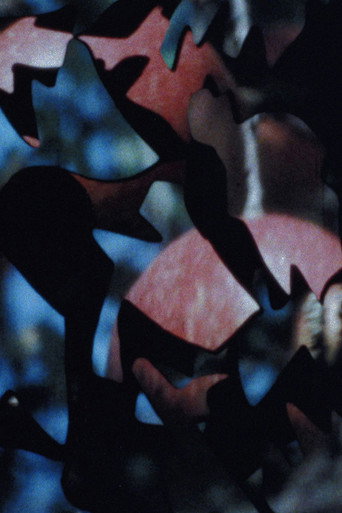
West Virginia industrial landscapes are collaged on an optical printer through a series of jagged shapes that transform the photographed scenes into a semi-abstract kinetic field. The technique developed by Brand in his earlier films, extends the already complex visual idiom by inlaying social, sexual, personal and political subject matter. Woven into the fabric of the film is the story of Fred Carter, a retired coal miner and black lung activist who was framed by the Federal Government in its effort to undercut the black lung movement and to stop his bid for president of the United Mine Workers Association. His story is told through fragments of documentary interviews and by a poet whose narrative forms a counter theme within the film. The film’s thematic content and formal visualizations sit in precarious balance.
Split Decision · 1979Split Decision
★ 10.01979
MovieDramaAnimation
This film is a scrambled narrative that illustrates, in soap opera fashion, life of artists in Lower Manhattan and at the same time dramatizes questions about the nature of filmic representation. Split decision is a boxing term used when the judges divide their votes in finding a winner. In this case the fight is between the two heroes of the film who are seen intermittently in a bar, negotiating a pick-up, and at home, breaking up in a domestic quarrel. The fight is also in the telling, between modes of conventional representation and modes of radical representation - between conventional continuity editing, and abstraction created through computer generated grids. The film features an appearance by Carolee Schneemann and digital imaging from before the era of personal computers.
Angular Momentum · 1973Angular Momentum
★ 10.01973
Movie
Nearly continuous colour changes rotating around a spectrum, occurring at varying speeds of rotation and in varying values of light. Colours are seen on the scraped area starting nearly white and rotating very slowly. As the film progresses the colour values become darker and the speed of rotation increases until by the end of the film, the colour is nearly black and is rotating around the spectrum about once per second. On the right the opposite occurs, starting nearly black, rotating very slowly. The moment to moment combination of colours and values is a function of the varying rate of rotation.
Susie's Ghost · 2011Susie's Ghost
★ 10.02011
Movie
Susie's Ghost is about the mystery of the marks we make and leave behind. The “Susie” in the title refers to a sibling but the "ghost" refers more generally to lingering feelings of loss. The cinematography and performance both express a tentative presence and diffuse sense of disappearance. Is she looking for something? Is she really there? We shot with aging 16mm film in my downtown Manhattan neighborhood, just before construction mania obliterated the last traces of the manufacturing district I’d moved into years earlier.
Circles of Confusion · 1974Circles of Confusion
★ 10.01974
Movie
In this film, circles of colored light (red, green, blue) pulsate and flicker as they move around the frame. Where they intersect, they display a variety of secondary colors. The term, circles of confusion belongs to the physics of the lenses. Here it has to do with the focus of light. Here it refers to the focus of mental and emotional energies as an irrational system for composing a film.
Home Less Home · 1991Home Less Home
★ 8.01991
MovieDocumentary
People who are homeless reveal homelessness from their own experiences dispelling common misconceptions and prejudices. Told as a personal journey, the film gives a broad analysis of the causes and conditions of homelessness while it analyzes news, TV reports and historical images of poverty. This film presents new ways to look at homelessness, displacing the debate from questions of charity to ones of social justice.
Huevos a la mexicana · 2018Huevos a la mexicana
★ 7.52018
Movie
This is my digital/analog contribution to “Xochimilco Treasure Hunting” in Mexico City on the final day of "HAZLO TU MISMO," Do-it-Yourself Independent Analog Film Laboratory Encounter, Sept. 9, 2018.
Sound Strip/Film Strip · 1972Sound Strip/Film Strip
★ 3.01972
Movie
Sound Strip / Film Strip is Paul Sharits' first "Locational" work, made in collaboration with Bill Brand. The piece was commissioned for the 1972 opening exhibition of the Contemporary Arts Museum, Houston,Texas. “...Sound Strip / Film Strip consists of four film loops simultaneously projected sideways so that the four images abut one another horizontally. Sharits made each loop by filming colored surfaces, scratching the film, projecting it so that the sprocket holes showed on the screen; he then filmed that projection, scratched the result, and projects that as the final object. The resulting image is a continuous flicker of various color ranges with both actual and ‘virtual’ scratches and sprocket holes running horizontally (normally vertically) across the screen. Thus, Sharits is working with filmic abstraction which employs no image save for that inherent in the medium itself....”
Home Movies 1971-81 · 1985Home Movies 1971-81
1985
MovieDocumentary
Home movies shot on Super 8mm by W+B Hein over 10 years.
Organic Afghan · 1969Organic Afghan
1969
Movie
A claymation and abstract object animation consisting of organic shapes and crocheted afghan squares synchronized to an original guitar duet by classmates Ray Goldstein and Nick Katzman. This is Bill Brand's first 16mm film completed in 1969 while a student at Antioch College.
Tree · 1970Tree
1970
Movie
An old tree sits on a mound in an Ohio farm field. The filming of the tree and the metrical editing of the film is organized around the tree's natural elements: water, earth, root ends, roots, trunk, limbs, branches, leaves and sun.
Always Open/Never Closed · 1971Always Open/Never Closed
1971
Movie
A woman wakes up, gets dressed, makes breakfast and walks down the street. This daily ritual becomes extraordinary seen in a trance-like structure of continuous lap dissolves and continuous spectral color shifts.
Suite: Moxibustion · 1999Suite: Moxibustion
1999
Movie
Also a double portrait, this video is an inside-out variation on DOUBLE NEPHRECTOMY. Here, the video uses projected light to penetrate my own body picturing my sister in her trade as an acupuncturist. While she treats me through burning herbs (moxibustion) and acupuncture needling, the video imagines the body as landscape. The contradiction between her commitment to an ancient healing practice and her dependence for survival on modern high technology medicine is an implicit subtext of the video.
Orchard-Market · 2016Orchard-Market
2016
Movie
I filmed two Shanghai artists, Zhuang Yin and Zhao Bo, who took me to their favorite places. Yin chose a small grove of trees – an urban oasis surrounded by building construction. Bo chose a busy street market for plants and pets. With ink on xuan paper I made abstract shapes that I animated and composited into videos from the orchard and market.
Moment · 1972Moment
1972
Movie
In a 2.5 minute sequence, a simple series of ordinary gas station events is seen intermittently through the opening display. This sequence is then divided and rearranged 7 times in reverse order. Each time the divisions are greater in number (smaller in size) until finally the film appears to move smoothly backwards, divided by a single frame. The inspiration for the film as well as the title is derived from information theory where a 'moment' is defined as the shortest duration at which no distinction can be made between units of information. This work is a demonstration and exploration of the line between human information and machine information. It dynamically reveals film's basic unit, the frame.
More Like This
Couldn't load this row right now.