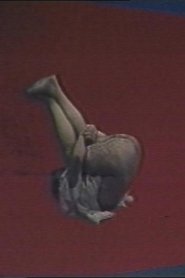
Rapture
1987 · 17 min
'Rapture' is a fierce vision of a Dionysian experience, a tightly controlled visual statement about the abandonment of self to heightened transportive states. It is also an exploration of the similarity between 'religious' and 'visionary' ecstasy and psychotic states.
Directed by Paul Sharits
Your Rating
Cast
 Paul Sharits
 Make it a double feature
29m together
Both from Paul Sharits.
More from Paul SharitsSee all →
 Wintercourse · 1962
Wintercourse
★ 7.41962
MovieDocumentary
Discovered in summer of 1985, of a set of “haiku-imagistic films” I did before coming to my characteristic style, as in Ray Gun Virus; I thought I’d destroyed all these pre-pure films, in about 1969-1970, the time of my separation from my first marriage. The film concerns my marriage, which lasted seven years; it was shot during its first year, when I was a painting student at the University of Denver. It is full of apprehensions, in a montage style which counterposes “opposites”: sexuality and religion; seasonal opposites; hopefulness undercut by fears of eventual separation (the image of a statue of two women, arm in arm, reading a book). I find it visually and kinetically interesting, after all these years. (Paul Sharits) —Canyon Cinema
 Tails · 1976
Tails
★ 7.21976
Movie
A series of tail ends of varied strips of film, with sometimes recognizable images dissolving into light flares, appear to run through and off of a projector. A romantic "narrative," suggesting an "ending," is inferred. This film can be projected at either sound speed (3 minutes) or silent speed (5 minutes).
 Word Movie · 1966
Word Movie
★ 6.81966
Movie
Single frame exposures of words.
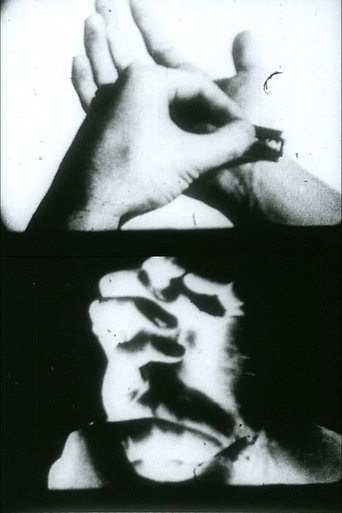 Wrist Trick · 1965
Wrist Trick
★ 6.81965
Movie
Various gestures of hand held razorblade, single frame exposures.
 T,O,U,C,H,I,N,G · 1969
T,O,U,C,H,I,N,G
★ 5.81969
MovieDrama
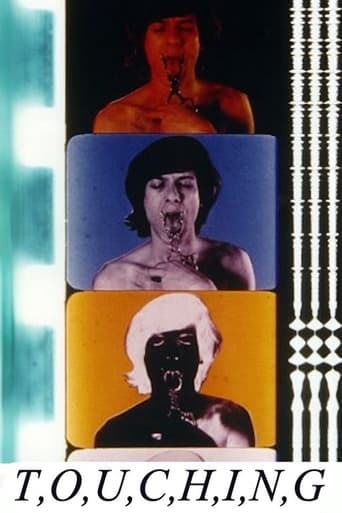
T,O,U,C,H,I,N,G uses flickering frames of solid color juxtaposed with positive and negative still images of a man—sometimes cutting off his own tongue with glitter-covered scissors, sometimes suffering a series of glitter-stained fingernail scratches across the face. Other rapidly alternating still images of eye surgery and a couple in the midst of intercourse. The soundtrack is a continuous looped recording of the word "destroy" over the entire length of the film.
 Bad Burns · 1982
Bad Burns
★ 5.31982
MovieAnimation
Two reels of mis-takes in shooting Part II of 3RD DEGREE; Film was loaded in camera improperly and the image slides about off-center and becomes blurred, creating some rather amusing and mysterious imagery. A made “found” object.
 Cinématon · 1978
Cinématon
★ 4.91978
MovieDocumentary
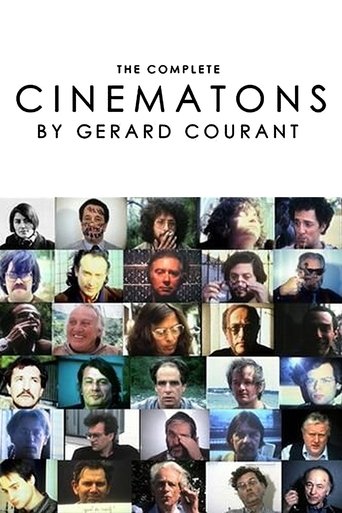
Cinématon is a 156-hour long experimental film by French director Gérard Courant. It was the longest film ever released until 2011. Composed over 36 years from 1978 until 2006, it consists of a series of over 2,821 silent vignettes (cinématons), each 3 minutes and 25 seconds long, of various celebrities, artists, journalists and friends of the director, each doing whatever they want for the allotted time. Subjects of the film include directors Barbet Schroeder, Nagisa Oshima, Volker Schlöndorff, Ken Loach, Benjamin Cuq, Youssef Chahine, Wim Wenders, Joseph Losey, Jean-Luc Godard, Samuel Fuller and Terry Gilliam, chess grandmaster Joël Lautier, and actors Roberto Benigni, Stéphane Audran, Julie Delpy and Lesley Chatterley. Gilliam is featured eating a 100-franc note, while Fuller smokes a cigar. Courant's favourite subject was a 7-month-old baby. The film was screened in its then-entirety in Avignon in November 2009 and was screened in Redondo Beach, CA on April 9, 2010.
 Razor Blades · 1968
Razor Blades
★ 4.91968
MovieDrama
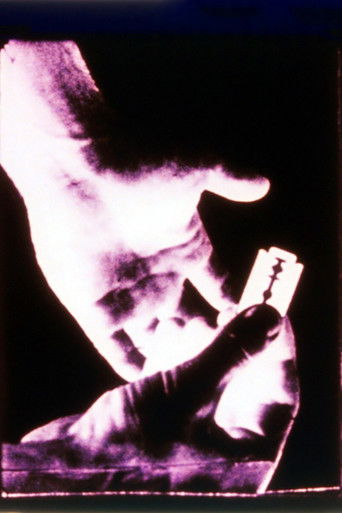
In Razor Blades, Paul SHARITS consciously challenges our eyes, ears and minds to withstand a barrage of high powered and often contradictory stimuli. In a careful juxtaposition and fusion of these elements on different parts of our being, usually occurring simultaneously, we feel at times hypnotised and re-educated by some potent and mysterious force.
 N:O:T:H:I:N:G · 1968
N:O:T:H:I:N:G
★ 4.51968
MovieAnimation
“The screen, illuminated by Paul Sharits’ N:O:T:H:I:N:G, seems to assume a spherical shape, at times – due, I think, to a pearl-like quality of light his flash-frames create … a baroque pearl, one might say – wondrous! … One of the most beautiful films I’ve seen.” – Stan Brakhage
 S:TREAM:S:S:ECTION:S:ECTION:S:S:ECTIONED · 1971
S:TREAM:S:S:ECTION:S:ECTION:S:S:ECTIONED
★ 4.31971
MovieAnimation
Streaming, scratched lines continuously appear two at a time over images of flowing water.
 Unrolling Event · 1965
Unrolling Event
★ 4.21965
Movie
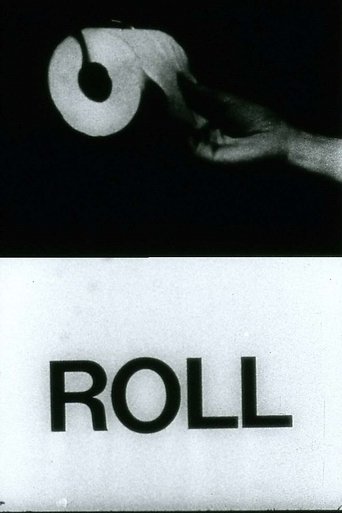
Toilet paper event, single frame exposures.
 Sound Strip/Film Strip · 1972
Sound Strip/Film Strip
★ 3.01972
Movie
Sound Strip / Film Strip is Paul Sharits' first "Locational" work, made in collaboration with Bill Brand. The piece was commissioned for the 1972 opening exhibition of the Contemporary Arts Museum, Houston,Texas. “...Sound Strip / Film Strip consists of four film loops simultaneously projected sideways so that the four images abut one another horizontally. Sharits made each loop by filming colored surfaces, scratching the film, projecting it so that the sprocket holes showed on the screen; he then filmed that projection, scratched the result, and projects that as the final object. The resulting image is a continuous flicker of various color ranges with both actual and ‘virtual’ scratches and sprocket holes running horizontally (normally vertically) across the screen. Thus, Sharits is working with filmic abstraction which employs no image save for that inherent in the medium itself....”
 Home Movies 1971-81 · 1985
Home Movies 1971-81
1985
MovieDocumentary
Home movies shot on Super 8mm by W+B Hein over 10 years.
 Fluxfilm Anthology 1962-1970 · 2010
Fluxfilm Anthology 1962-1970
2010
MovieDocumentaryFantasy
Feature-length compilation program presenting 37 out of 41 original fluxfilms produced and directed in the 1960s by Fluxus artists, including George Maciunas, Nam June Paik, Yoko Ono, Robert Watts, Paul Sharits, et al.
 3rd Degree · 1982
3rd Degree
1982
Movie
Three-screen film. On the first screen, close-ups of an agitated match in front of a young woman's fearful face. On the soundtrack: matches, warnings of a rattlesnake, the phrase: "Listen, I will not speak." The ribbon runs at variable speeds, sometimes blurring, sometimes slowing down, to stop, on which the image / celluloid begins to fry and to burn, then leaves, runs, stops again, leaves again ... On the second screen we see the first rephotographed; here the "burns" are both fixed or new (a burn in the second degree). On the third screen, we see the second screen rephotographed. The subject of the film is the fragility of the film, as medium, as well as the vulnerability of man. Both the film and the figure resist threats / intimidation / mutilations.
 Axiomatic Granularity · 1973
Axiomatic Granularity
1973
Movie
"There is a paradox in such artistically special (and significant) films as Sharits' very real and reflexively beautiful AXIOMATIC GRANULARITY. It is that in becoming so accessible and authentic through its refusal to be anything but itself - emulsion grain seen in color and movement - the film for most viewers is likely to be impenetrable ... the film begins to evoke a quiet flow of thought. That thought, however, is repeatedly returned to the light perceived on the screen as the film calls attention to itself through the random appearances of scratches, becoming simply and pleasantly what it is, refreshingly nothing more." - Anthony Bannon, Buffalo Evening News
More Like This
Couldn't load this row right now.