Reading Film From Knots by R.D. Laing

Reading Film From Knots by R.D. Laing

12 min

The first part of Reading Film from “Knots” by R. D. Laing shows various pages of a text written by Scottish psychoanalyst Ronald D. Laing where he converts real cases of human interaction into abstract and paradoxical verbal models.

Directed by David Lamelas

Your Rating

Make it a double feature

35m together

Reading Film From Knots by R.D. Laing
The Invention of Dr. Morel

Both from David Lamelas.

More from David LamelasSee all →
The DictatorThe Dictator · 1978
The Dictator
10.01978
Movie
Ficticious interview with a fictitious dictator.
The Invention of Dr. MorelThe Invention of Dr. Morel · 2000
The Invention of Dr. Morel
8.02000
MovieDramaMystery
About Dr. Morel who invents a machine to duplicate the woman he loved, Faustina, in virtual reality. A tale dealing with the impossibility of ever knowing for certain which parts of ourselves and our relationship with others exist only in our imagination.
Reading of an Extract from Labyrinths by J.L. BorgesReading of an Extract from Labyrinths by J.L. Borges · 1970
Reading of an Extract from Labyrinths by J.L. Borges
2.01970
Movie
The film Reading of an Extract from “Labyrinths” by J. L. Borges shows a young woman reading an essay by Argentinean writer Jorge Luis Borges titled Nueva refutacion del tiempo (New Refutation of Time) out loud. Her lips can be seen moving but her voice cannot be heard.
The Phantom
Next week
The Phantom · 2026
The Phantom
2026
Movie
Two female producers are commissioned to create a short documentary for an exhibition dedicated to Rubén Santantonín, an elusive figure of the Argentine avant-garde who died very young, in the late 1960s. However, the client imposes one unexpected condition: the video must be made together with David Lamelas, Santantonín’s former collaborator and today an internationally recognized figure of conceptual art. At first, the plan seems clear and limited in scope: Lamelas, accompanied by a young film crew, gathers archival materials, documents the few surviving works, and interviews curators and major artists – such as Luis Felipe Noé and Marta Minujín – who, along with Santantonín and Lamelas, peopled the legendary scene at the Instituto Torcuato Di Tella. Lamelas gradually realizes that reconstructing the story of his friend also means confronting a series of gaps and contradictions.
Cumulative ScriptCumulative Script · 1971
Cumulative Script
1971
Movie
A drama unfolds in London parkland, as Lamelas balances modernist autocritique with the mimetic discourse of cinema.
Gente di MilanoGente di Milano · 1971
Gente di Milano
1971
Movie
David Lamelas was invited to mount a solo exhibition, a short film was shot with a stationary camera documenting everything that happened to enter its angle of view. At the same time, eleven photographs were taken at regular intervals.
To Pour Milk into a GlassTo Pour Milk into a Glass · 1972
To Pour Milk into a Glass
1972
Movie
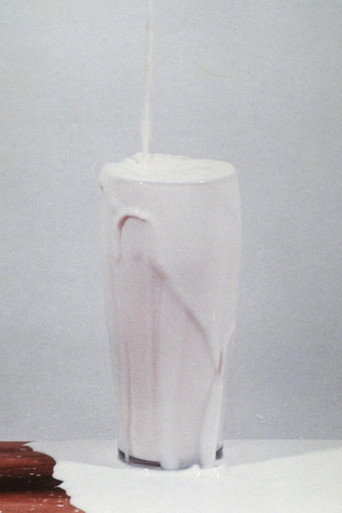
A simple gesture, introduced in the very title of the work, is repeated with slight variations – the glass is half filled, the content overflows, the glass breaks, the milk spills on the table – and constitutes the film’s only action. Lamelas rejects any type of narration or human presence, and the filmic code – reduced and dissected – comprises the only argument.
The Desert PeopleThe Desert People · 1974
The Desert People
1974
Movie
This fictional documentary film about a Native American reservation critiques the practice of film production itself.
Time as ActivityTime as Activity · 1969
Time as Activity
1969
Movie
In Time as Activity - Düsseldorf (1969), David Lamelas visually reveals how the same moment can be experienced in different ways. The video is built on four sequences; in each one a fixed camera portrays the city of Düsseldorf from different locations during a lapse of four minutes. At the start of each sequence, a small cardboard sign appears to indicate the precise time when the four minutes were recorded; the frame remains still and encompasses a wide angle, in which objects or actions are out of focus. The activities that unfold before the camera and the way they pass are an account of the infinite ways in which the same four minutes may be experienced simultaneously.
"Interview” with Marguerite Duras"Interview” with Marguerite Duras · 1970
"Interview” with Marguerite Duras
1970
Movie
A conversation with French writer Marguerite Duras, filmed in the calm atmosphere of her country house.

More Like This

Couldn't load this row right now.

Rate this film

Your ratings make Midnight smarter