Memoirs of My Nervous Illness

Memoirs of My Nervous Illness

1993 · 76 min

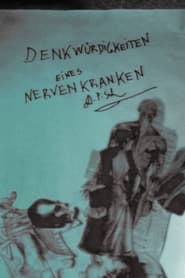
On the 28th of October 1884 Daniel Paul Schreber, candidate of the National Liberal Party in Chemnitz, suffered a heavy defeat at the elections of the German Reichstag. He was taken up in the mental clinic of the Leipzig University soon afterwards. To his rehabilition he wrote an extensive piece of work, "Denkwürdigkeiten eines Nervenkranken" (Memoirs of My Nervous Illness), which was published in 1903 and led to his temporary dismissal. Hereby Schreber became the most quoted psychiatric patient in scientific literature.

Directed by Ernst Schmidt Jr. · Written by Daniel Paul Schreber

Your Rating

Make it a double feature

2h 42m together
Memoirs of My Nervous Illness
The Total Family

Both from Ernst Schmidt Jr..

More from Ernst Schmidt Jr.See all →

The Total FamilyThe Total Family · 1981
The Total Family
★ 9.01981
Movie
Baron Childerich III of Bartenbruch considers himself to be a descendant of the Merovingian dynasty and he has drawn up a chart of marriages and adoptions which show that he is his own father, grandfather, father-in-law, and son-in-law. He aims at achieving the "total family" based on one man. He persuades his french relative, Pippin, to help him. But the latter lets him down and breaks up the family... Among those who belong to the (surrounding) world of the Baron are Dr. Döblinger, a writer, who has formed a band of muggers and Professor Horn, a psychiatrist, who quiets his patients by leading them on nose rings and beating them up... Family satire with numerous personal and literary allusions based on the novel of the Austrian writer, Heimito von Doderer.
ViennaFilm 1896-1976ViennaFilm 1896-1976 · 1977
ViennaFilm 1896-1976
★ 7.01977
MovieDocumentary
This film is a kind of anthology about Vienna, from the invention of film to the present day. The aim is to break down the usual clichéd "image of Vienna" such as that found in the traditional "Vienna Film" by juxtaposing documentary footage, newly shot material and subjective sequences created by various artists. Individual, self-contained sections of the film gain new meaning within the context of historical material. Familiar sites appear estranged when edited together with historical scenes. Other scenes appear like a persiflage or satirical. The film does not incorporate any commentary whatsoever. It is a collage of diverse materials aimed at conveying a distanced image of Vienna to the viewer
NN · 1978
N
★ 4.51978
Movie
Recorded during a presentation of the "Performance Art Festival" in the Modern Art Galerie, Vienna. The presentation was officially put to an end by the police because of the infernal sound made by the accompanying noise orchestra. In this film short shots have been "mounted" in the camera. The film material is shown twice, whereas the sound is composed over the entire length of the film (out of elements of the real sound from the performance). (E.S.jr.)
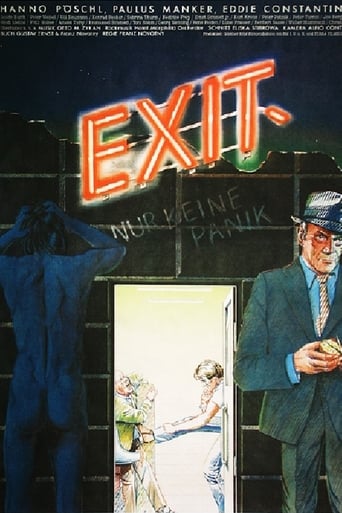
Exit... But No PanicExit... But No Panic · 1980
Exit... But No Panic
★ 4.41980
MovieActionCrime
A guy having sex with a woman on a rooftop – just to get her coffee-machine.
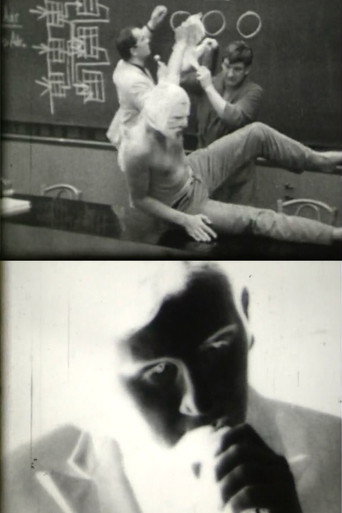
Kunst & RevolutionKunst & Revolution · 1968
Kunst & Revolution
1968
MovieDocumentary
‘Kunst & Revolution is a documentation on the famous action known as the “filthy uni mess”, which led to a jury court trial. I only had a few metres of film with me and they were quickly spent, but still the film gives one a rough impression of the events. As a whole mythology quickly arose around the event, I altered the material to counteract this effect (through repetition, and adding other material, for instance from a film about keeping dogs, and my own leftover footage from the Muehl action number 54 ‘Im Freudenauer Wasser’).’ In film 16 of his anthology Ernst Schmidt Jr. documented the actions of Günter Brus, Otto Muehl, Peter Weibel and Oswald Wiener.
Yes/NoYes/No · 1968
Yes/No
1968
Movie
Expanded cinema with a real and a projected curtain. (This film is part of the 20 Action and Destruction Films.)
CheersCheers · 1968
Cheers
1968
Movie
This is a film with minimal content. Using a film pen, a line was drawn across a strip of clear leader, until it hit the edge of the frame ("cheers"), and then the line was drawn back to the other side ("cheers"), etc. This strip functioned as the film negative. The projection is the drawn out line as a white line that wanders back and forth, bringing light and darkness into the theater. Because of this one should not only watch the movie screen, but also the light that comes out of the projector and the reflections in the theater. A "light play." (E.S.jr.)
SaallichtSaallicht · 1974
Saallicht
1974
Movie
Ernst Schmidt Jr. SAALLICHT (1974, 30 sec, 16mm)
BodybuildingBodybuilding · 1967
Bodybuilding
1967
Movie
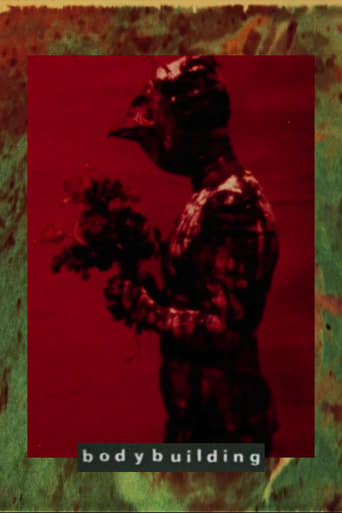
In May 1965, Ernst Schmidt Jr. films the Otto Muehl performances Rumpsti Pumsti and Body Building. In this period Muehl conceives his actionist works almost exclusively for photographic and film documentation. The necessity of a spontaneous confrontation with the public, which plays a major role in Muehl's later actions, does not apply to these works.
StartStart · 1973
Start
1973
Movie
From START to the end, from the film title to the END title. The title initiates its repetition in the black-and-white image: the banner START flutters in the wind, presumably above the starting point of a race. We are in the middle of the film, which will end four seconds later; at the same time, the banner is another film title, even with the signature of a production company, as in mainstream cinema – "CAROP AUTOVERLEIH", as if this car rental named CAROP were a cinema corporation or (film) distributor. After a wild pan, the "Verleih" (distributor) presents the action: a motorcyclist races through the image of an enduro race. The film is less enduring, but it has shown everything it can anyway. (The enduro race in Kenneth Anger's Scorpio Rising is much more boring.) (Drehli Robnik)
Film ScrapsFilm Scraps · 1966
Film Scraps
1966
Movie
Material actions: Otto Muehl. Montage of left-over film material from film scraps, amateur films, film leaders, recordings of material happenings, etc. Edited according to an exact plan (60 blocks of 10 takes each), then largely drawn over. My most destructive film, the "model for a futuristic newsreel."
StonesStones · 1965
Stones
1965
Movie
Steine (Stones) is a documentary film on a sculptorsŽ symposium in St. Margarethen, Burgenland. Behind this short description of content lies one of the most intelligently filmed and concepted documentary films in the history of Austrian film. The date of the last showing of this film could not be reconstructed.
WhiteWhite · 1968
White
1968
Movie
In a blank film, holes were punched with a office hole-punch. During the projection, only the black scratches present in the material, which form over the course of time, can apparently be seen in the holes as well. (E.S.)
Color FilmColor Film · 1967
Color Film
1967
Movie
In this film the goal of destroying film semantics has been consistently followed though. Part of the film is composed of a seemingly collision of picture and sound. Whilst filming, the colors called out in the sound were really filmed. Because of the "mistakes" made (unfocusing, copying process, color temperature) the colors in the final printing were wrong. The audience is then confronted with these discrepancies. (E.S.jr.)
Film AlphabetFilm Alphabet · 1971
Film Alphabet
1971
Movie
ABCDEFGHIJKLMNOPQRSTUVWXYZ - each letter is one frame (1/24 of a second) long and each letter originates from a company sign. The film shows the paradoxical relationship between film and written language. (E.S.jr.)
Snip, SnipSnip, Snip · 1968
Snip, Snip
1968
Movie
This film has two parts. In the first part, the film material is on 8mm uncut film, so that in the 16mm projection a 4-fold film can be seen. In the second part of the film, the 16mm film is shown in full size, that means the picture is now enlarged four times its size. I drew over the film after the fact, and abstracted it in many different ways. (E.S.jr.)

More Like This

Couldn't load this row right now.
Rate this film

Your ratings make Midnight smarter