Directing
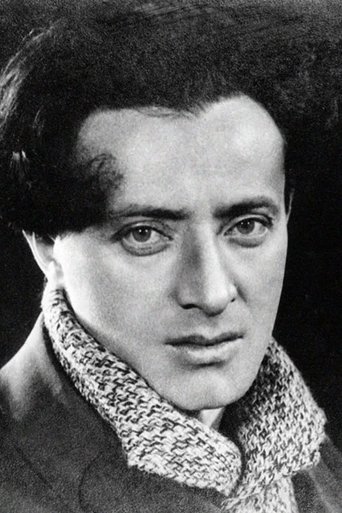
Fridrikh Ermler
Born May 13, 1898 · Rezekne, Latvia
Died July 12, 1967 · aged 69
Fridrikh Markovich Ermler[a] (13 May 1898 – 12 July 1967) was a Soviet film director, actor, and screenwriter. He was a four-time recipient of the Stalin Prize (in 1941, twice in 1946, and in 1951). After studying pharmacology, he joined the Czarist army in 1917 and soon took part in the October Revolution on the side of the Bolshevists. Captured and tortured by the White army, he only became a f…
Known For
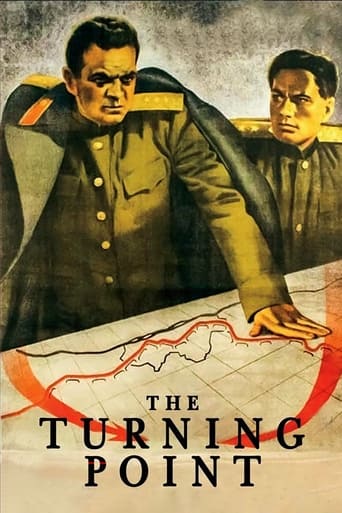 The Turning Point · 1945
The Turning Point
★ 3.91945
MovieDramaWar
The film tells the story of those who took part in the Battle of Stalingrad in 1942, which became a turning point in the Great Patriotic War. For five months, the city resisted the Nazi offensive. Surrendering Stalingrad to the enemy would have meant losing the war, but holding on to the city seemed almost impossible.
 Fragment of an Empire · 1929
Fragment of an Empire
★ 5.71929
MovieDrama
Director Frederick Ermler’s last silent feature and the last of four collaborations with actor Fiodor Nikitin. Nikitin plays an officer who spends a decade after the Great War as a shell-shocked amnesiac, until a glimpse of a woman through a train window sparks the return of his memory. He makes his way back to St. Petersburg, now Leningrad, a man out of time who struggles to make sense of the new society brought about by the revolution.
 Chapayev is with Us · 1941
Chapayev is with Us
★ 3.31941
MovieWar
Short propaganda film released to raise army morale during first months of war. Civil War hero and Red Army commander Vasily Chapayev (killed in 1919 by White Army officers then drowned in the Ural river) swims ashore but it's the summer of 1941. Chapayev asks who are Soviets fighting off this time, hears that it's Germans once again and then gives an inspiring speech. He is played by Boris Babochkin who famously portrayed Chapayev in 1934 biopic.
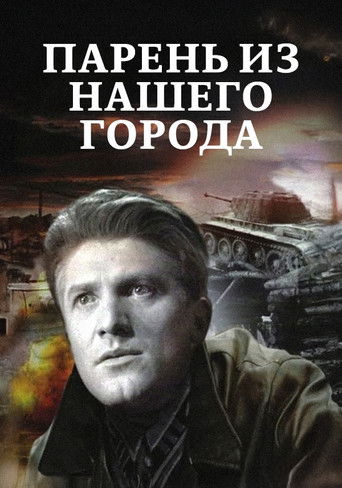 Lad from Our Town · 1942
Lad from Our Town
★ 5.01942
MovieDramaWar
In the summer of 1932, Sergei Lukonin, a young man from Saratov, leaves his hometown for the distant city of Omsk to attend tank school. His fiancée, Varenka, who soon became an actress, remained in Saratov. In 1936, Sergei went to fight in the Spanish Civil War. He was wounded, taken prisoner, escaped, and returned to training battles, with June 1941 looming ahead.
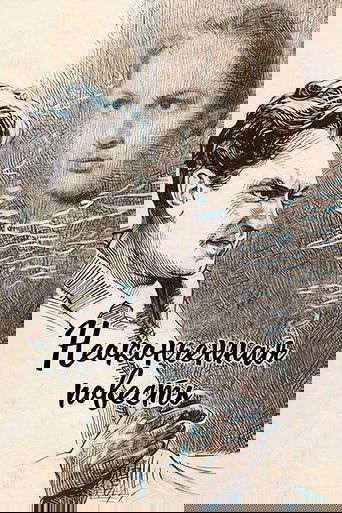 Unfinished Story · 1955
Unfinished Story
★ 5.31955
MovieDramaRomance
The local doctor Yelizaveta Maksimovna is a beautiful woman and a wonderful sympathetic person. She is lonely, although she is cared for by a confident and promising colleague. Yelizaveta Maksimovna has one patient, a manly, full-energy ship builder Yershov, chained to the bed with a paralysis of both legs. All doctors recommend him rest, and Elizaveta Maksimovna advises to work and not feel sorry for herself. Yershov with all his heart falls in love with his doctor, and she loves him, but she does not dare to say her feelings. Ershov thinks that he has no hopes, but...
 Smile! · 2024
Smile!
★ 3.02024
MovieDocumentary
A docudrama presenting the events which explain how and why Charles Spencer Chaplin made alterations to his original ending of the famous movie “Modern Times” following his encounter with the Soviet director Fridrikh Ermler.
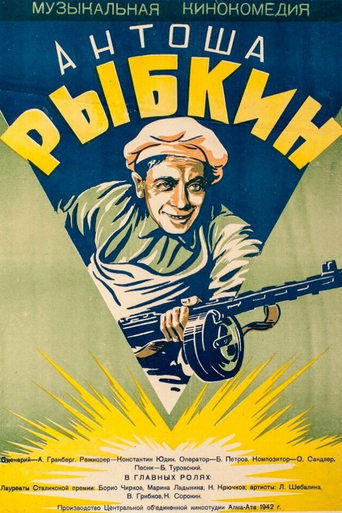
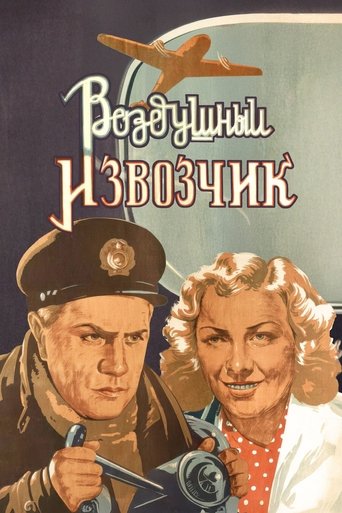 Air Taxi · 1943
Air Taxi
★ 5.71943
MovieComedyRomance
A musical romantic comedy set in Soviet Union during the first years of WWII.
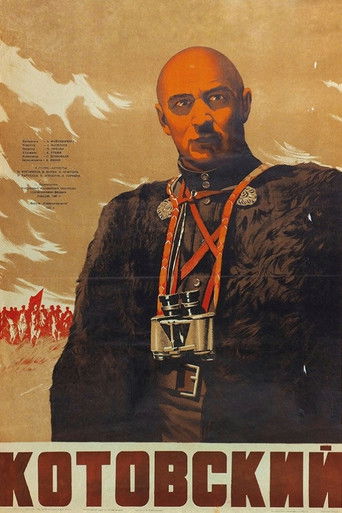 Kotovsky · 1943
Kotovsky
★ 9.71943
MovieWarHistory
Kotovsky, who went a long revolutionary way and became the recognized military commander of the cavalry troops: commander, brigade commander, commander. Six times he escaped from prison, was sentenced to death, and again escaped to become one of the most ardent warriors of the revolution. His famous equestrian brigade fought with the enemy near Kiev and the Belaya Tserkov, at Nikolaev and Odessa, and did not know defeat anywhere.
Filmography
Sort

 Our Cinema · 1940
Our Cinema
★ 9.01940
MovieDocumentary
(archive footage)