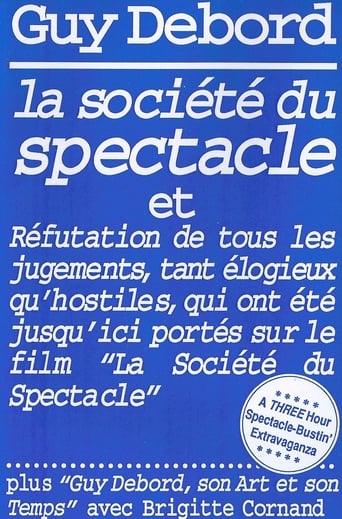
The Society of the Spectacle
1974 · 90 min · ★ 6.7 · Documentary
Guy Debord's analysis of a consumer society.
Directed by Guy Debord · Written by Guy Debord
Your Rating
Where to Watch
Provider data from JustWatch via TMDB →Cast
-
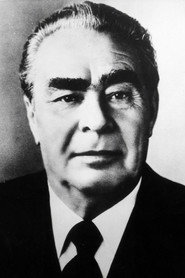
Leonid Brezhnev Self (archive footage) -
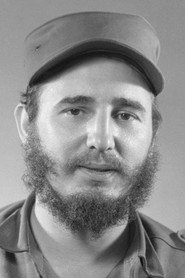
Fidel Castro Self (archive footage) -
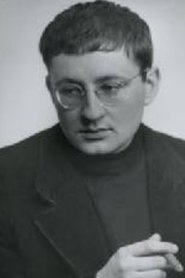
Guy Debord Narrator (voice) -
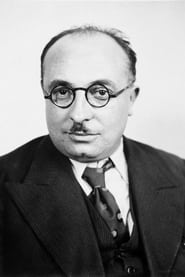
Jacques Duclos Self (archive footage) - R Robert Fabre Self (archive footage)
-
Nino Ferrer Self (archive footage) -
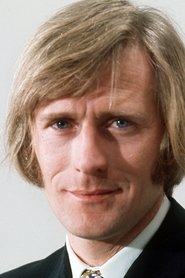
Valéry Giscard d'Estaing Self (archive footage) -
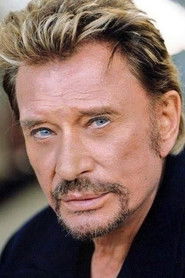
Johnny Hallyday Self (archive footage) -
George Harrison Self (archive footage) -
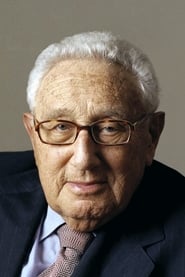
Henry Kissinger Self (archive footage) -
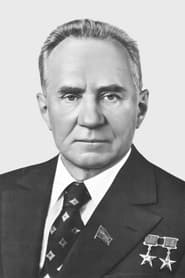
Alexei Kosygin Self (archive footage) -
Mao Zedong Self (archive footage)
More from Guy DebordSee all →
Koyaanisqatsi · 1983Koyaanisqatsi
★ 7.91983
MovieDocumentaryMusic
Takes us to locations all around the US and shows us the heavy toll that modern technology is having on humans and the earth. The visual tone poem contains neither dialogue nor a vocalized narration: its tone is set by the juxtaposition of images and the exceptional music by Philip Glass.
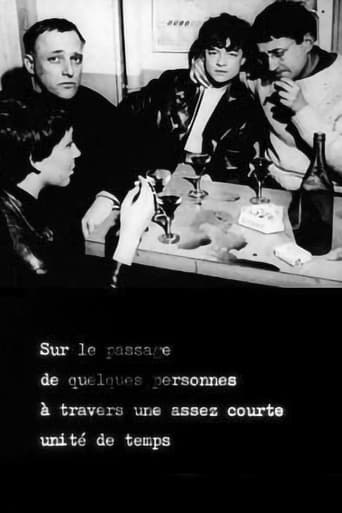
On the Passage of a Few People Through a Relatively Short Period of Time · 1959On the Passage of a Few People Through a Relatively Short Period of Time
★ 7.51959
Movie
This short film can be considered as notes on the origins of the situationist movement; notes which thus naturally include a reflection on their own language.
Refutation of All the Judgements, Pro or Con, Thus Far Rendered on the Film "The Society of the Spectacle" · 1975Refutation of All the Judgements, Pro or Con, Thus Far Rendered on the Film "The Society of the Spectacle"
★ 7.11975
MovieDocumentary
Refutation of All the Judgements, Pro or Con, Thus Far Rendered on the Film "The Society of the Spectacle"
Critique of Separation · 1961Critique of Separation
★ 7.11961
MovieDocumentary
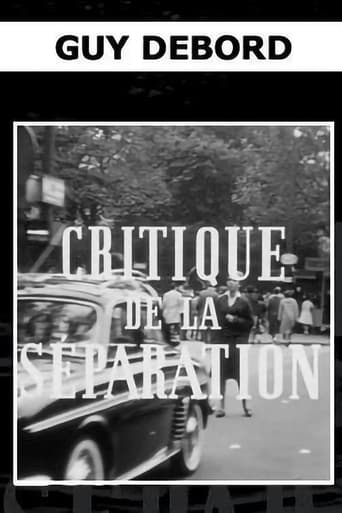
Debord’s eighteen-minute Critique of Separation directs its experimental attentions to “the documentary.” Debord draws from a catalogue of newsreel footage and book covers, rephotographed photographs, views of Paris and its neighborhoods, and a catalogue of disabused, seemingly offhand footage of him and his friends in the porous zone comprising the cafe and the street.
Howlings in Favour of De Sade · 1952Howlings in Favour of De Sade
★ 6.91952
MovieDrama
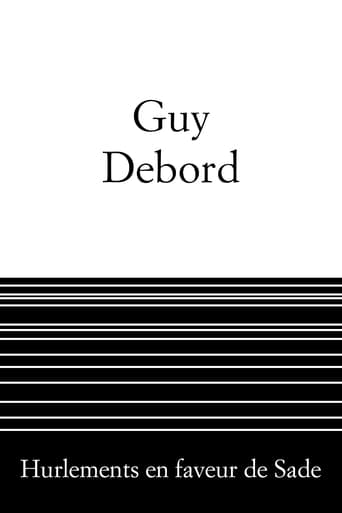
Debord directed his first film, "Hurlements en faveur de Sade" in 1952 with the voices of Michele Bernstein and Gil Holman. The film has no actual images; instead, it shows bright white when there is speaking and black when there is not. Long silences separate speaking parts. The film ends with 24 minutes of black silence.
We Spin Around the Night Consumed by the Fire · 1978We Spin Around the Night Consumed by the Fire
★ 6.71978
MovieDocumentary
A Latin palindrome is the title of Guy Debord's last film, in which he, as narrator, explains that he will make neither concessions to the tastes of his viewers nor to the dominant ideas of his day. After extensively insulting the audience that goes to the cinema to forget its heteronomous life, the film becomes autobiographical, using images from the world of spectacle: advertising brochures, clips from feature films (Les enfants du paradis), comics, aerial footage of Paris, tracking shots through Venice, photographs of friends – all commented on by Debord, with an at times melancholy undertone: "This Paris no longer exists." His assessment is that one of the great pleasures of his life has been the sensation of the passage of time, and as a witness to the disintegration of social order, he has loved his epoch.
Guy Debord, son art et son temps · 1995Guy Debord, son art et son temps
★ 5.71995
MovieDocumentary
Except for a few brief evocations of Debord’s “art” during the first ten minutes or so, most of this “antitelevisual” video consists of television clips illustrating the extreme degradation and delirium of the present society. It’s a powerful denunciation, but not so deft and subtle as Debord’s films, perhaps because it was made during the worsening stages of his final illness. Presumably intended as a parting shot at the society he detested, it was completed shortly before his death in November 1994 and shown January 9, 1995, on a French cable channel along with La Société du Spectacle and Réfutation de tous les jugements (whence the video copies that have since circulated).
Venice 70: Future Reloaded · 2013Venice 70: Future Reloaded
★ 5.12013
MovieDramaDocumentary
Made for the Venice Film Festival's 70th anniversary, seventy filmmakers made a short film between 60 and 90 seconds long on their interpretation of the future of cinema.
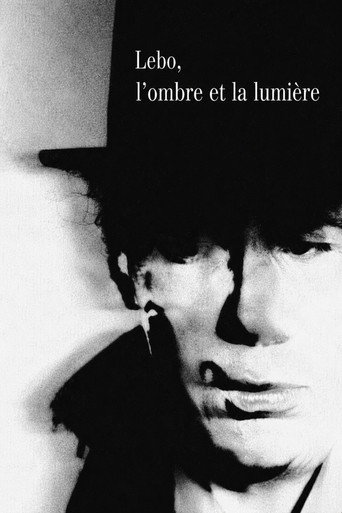
Lebo, l'ombre et la lumière · 2007Lebo, l'ombre et la lumière
2007
MovieDocumentary
Murdered in a parking lot on Avenue Foch in March 1984 at the age of 52, Gérard Lebovici found himself at the intersection of several worlds: the media industry, artistic ambitions, and radical subversion. Was it a mafia hit, a political assassination...? The investigation never reached a conclusion. Founder of the Artmédia actors' agency, film producer and distributor, creator of the Champ libre publishing house, friend of Guy Debord, Gérard Lebovici found himself at the extreme melting point of the tensions that mark our world: money, images, celebrity, networks, revolt, radical criticism, and marginality. Tracing an unusual journey, this portrait of "Lebo" paints a picture of an era that began with the radical protests of May 1968 and ended with the cynicism of the 1990s.
More Like This
Re-Births · 2017Re-Births
★ 7.42017
MovieDocumentary
A documentary film depicting five intimate portraits of migrants who fled their country of origin to seek refuge in France and find a space of freedom where they can fully experience their sexuality and their sexual identity: Giovanna, woman transgender of Colombian origin, Roman, Russian transgender man, Cate, Ugandan lesbian mother, Yi Chen, young Chinese gay man…
Land Without Bread · 1933Land Without Bread
★ 7.11933
MovieDocumentary
An exploration —manipulated and staged— of life in Las Hurdes, in the province of Cáceres, in Extremadura, Spain, as it was in 1932. Insalubrity, misery and lack of opportunities provoke the emigration of young people and the solitude of those who remain in the desolation of one of the poorest and least developed Spanish regions at that time.