Kiss My Royal Irish Ass (K.M.R.I.A.)

Kiss My Royal Irish Ass (K.M.R.I.A.)

1992 · 5 min

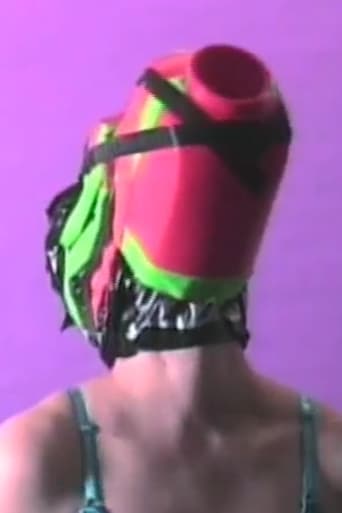
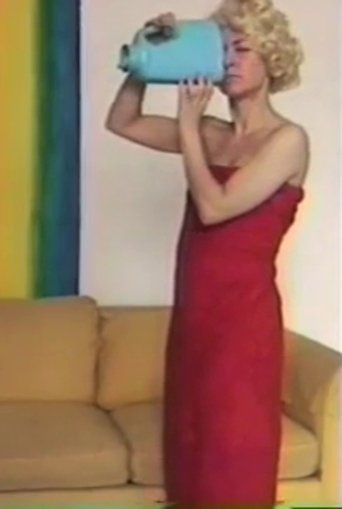
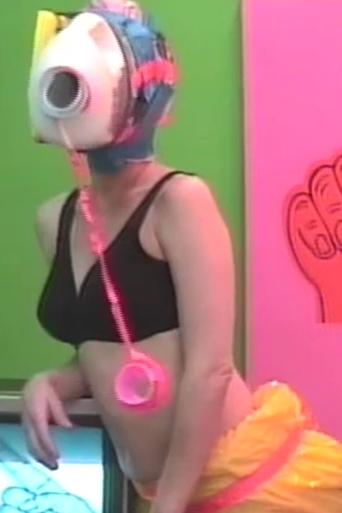
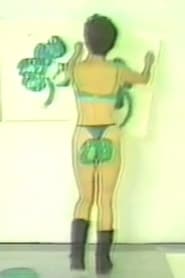
In this documentation of a performance at the Andrea Rosen Gallery in New York, Donegan uses her body as an art-making tool, and toys with identity politics as well.

Directed by Cheryl Donegan

Your Rating

Cast
Make it a double feature

8m together

Kiss My Royal Irish Ass (K.M.R.I.A.)
Whoa Whoa Studio (for Courbet)

Both from Cheryl Donegan.

More from Cheryl DoneganSee all →

Whoa Whoa Studio (for Courbet)Whoa Whoa Studio (for Courbet) · 2000
Whoa Whoa Studio (for Courbet)
★ 10.02000
Movie
This film refracts Donegan's earlier performance work through the lens of a studio art practice. The artist subverts the tradition of studio painting by using a computer to make simple line drawings. Later, the computer is transformed into a canvas through the regressive act of directly marking the monitor. Painting is related to scatology as a correlation is made between art making and infantile fantasy.
FileFile · 2003
File
★ 5.52003
Movie
Scraps of color and pattern slide across the screen in a stop and start progression that frustrates all sense of spatiality and depth. David Schafer's delirious soundtrack adds to the disorientation.
Old, TemporaryOld, Temporary · 2005
Old, Temporary
2005
Movie
An obscure, appropriated Yoko Ono monologue is applied to a banal setting.
FlushingFlushing · 2004
Flushing
2004
Movie
Shot at the Flushing Mall in Queens, New York, "Flushing" is tour of a mall that doesn't live up to the glossy standards of typical American consumer palaces, but is thereby, perhaps a better place to understand the yearnings for fantasy via retailing.
VineVine · 2016
Vine
2016
Movie
A series of videos put together and updated regularly until Vine closed.
Blood SugarBlood Sugar · 2012
Blood Sugar
2012
Movie
As the title suggests, a bodily metaphor, metabolism, is at play in the continuous cycle and recycle of images. As the models emerge and recede into darkness, images and patterns appear, degrade and reemerge to an uninterrupted beat. The cycle continues, just as we continue to flow and burn.
LiederLieder · 2000
Lieder
2000
Movie
Donegan sets up a series of charged relationships -- between artist and model, art object and artistic "gesture," performer and viewer. The "lieder" of the title (German for "songs") are the amplified squeaks of Donegan's swiveling metal stool as it rotates.
PractissePractisse · 1994
Practisse
1994
Movie
To the accompaniment of the only extant recording of James Joyce reading from his own work, Donegan uses a clear cellophane hood and a pane of glass to create another of her "face paintings." The performance is intercut with the artist painting over her own image as it appears on a video monitor, complicating the relation between her performance and the ways that technology both records and redefines the artist's work.
CherylCheryl · 2005
Cheryl
2005
Movie
Presenting "Cheryl" the home-shopping motivator as a surrogate and cheesy consumer goods as art objects, Cheryl the artist questions hype and material value in a personality-driven art market.
CellardoorCellardoor · 2000
Cellardoor
2000
Movie
Life as seen through the lens of a plastic bottle.
RefusesRefuses · 2006
Refuses
2006
Movie
Refuses began as a visual extension of Carolyn Bergdahl's poem Fuses (after Carolee Schneemann). Just as Bergdhl's poem speaks to Schneemann's taboo-shattering 1964-66 film, Donegan's Refuses is a direct response to the poem. Using Bergdahl's poem as a template, Donegan creates a structured visual language that leans as much on formal rules as it does on content. In Donegan's silent collage of seemingly disparate images culled from Internet searches and home video footage, each new clip directly corresponds to a word in the original Bergdahl poem; the apparent stream of consciousness is governed by a rigorous set of rules.
Scenes and CommercialsScenes and Commercials · 1997
Scenes and Commercials
1997
Movie
A recording of the Wilson Brothers trying to cut the single "Help Me Rhonda" under the overbearing scrutiny of father Murray, tells the story of the struggle to achieve the illusion of carefree, American fun.
LineLine · 1996
Line
1996
Movie
Writes Donegan: "... The video is the centerpiece of a large project comprised of paintings and video inspired by the Jean-Luc Godard film Le Mépris. This project does not seek to analyze or critique the Godard film, but to use it as a model, as an inspiration, as a 'classical' language through which other stories can be told... I myself 'play' the roles of both Camille (B. Bardot) and Paul (M. Piccoli). In the Godard film, the characters meet over the recreation of Homer's Odyssey as a Hollywood-style film. In Line, my Homer, the representative of the noble, classical past or Father artist, is the American painter Barnett Newman. In the video, the characters struggle over how to recreate one of his classical 'zips.' This abstract expressionist gesture of presence, of affirmation is for them a mark of cancellation, of destruction. Are they wrong?"
I Still Want to DrownI Still Want to Drown · 2010
I Still Want to Drown
2010
Movie
The piece is a short lament and meditation on housework, heartbreak and posing, keeping up appearances and appearing to keep up.
Alive! Artist! Model! Pleasure!Alive! Artist! Model! Pleasure! · 1998
Alive! Artist! Model! Pleasure!
1998
Movie
Donegan calls into question the institutional armature that surrounds a work of art, and investigates boundaries between "high" and "low" culture.
Stop Me If You Think You've Heard This One BeforeStop Me If You Think You've Heard This One Before · 2008
Stop Me If You Think You've Heard This One Before
2008
Movie
Director Donegan recasts herself as Warhol superstar Viva from his 1967 film "Nude Restaurant".

More Like This

Couldn't load this row right now.
Rate this film

Your ratings make Midnight smarter