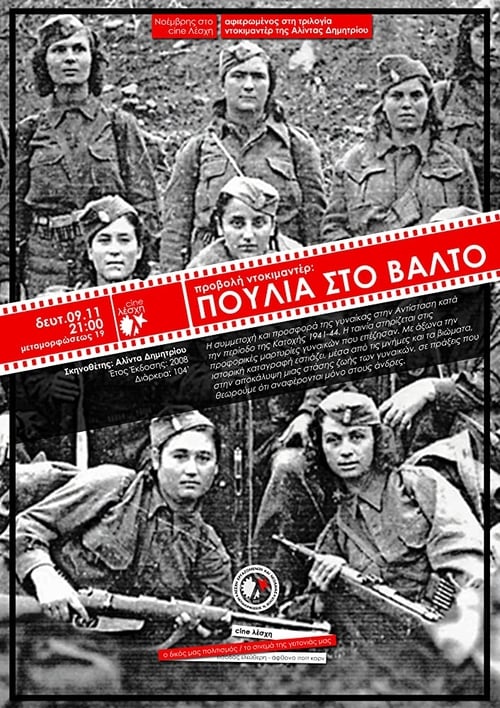
Birds in the swamp

Birds in the swamp

2008 · Documentary

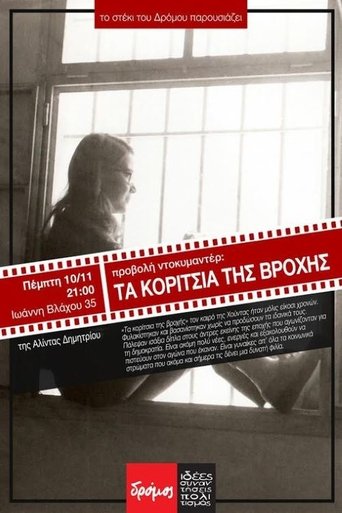
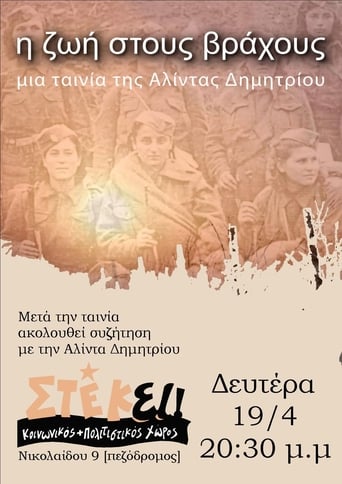
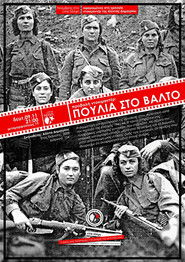
Τhe film refers to the participation and contribution of the woman in the Resistance during the period of Occupation 1941-1944, as well as the consequences she suffered. It is based on the oral testimonies of the women who survived, based on the historical route.

Directed by Alinta Dimitriou · Written by Alinta Dimitriou

Your Rating

Make it a double feature
Birds in the swamp
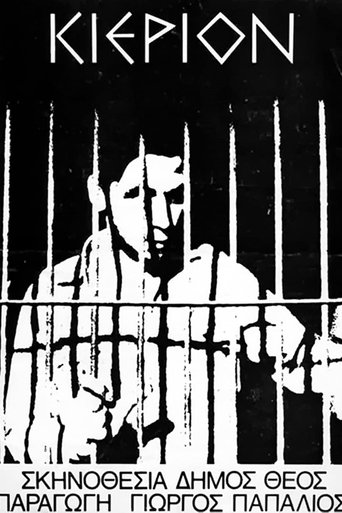
Kierion

Both from Alinta Dimitriou.

More from Alinta DimitriouSee all →
KierionKierion · 1974
Kierion
6.01974
MovieThrillerDrama
Athens 1967. The political assassinations and the background between the government and foreign powers, on the occasion of the "Polk Case", where an innocent leftist was convicted for the murder of an American journalist in Greece.
Among the RocksAmong the Rocks · 2009
Among the Rocks
2009
MovieDocumentary
Refers to the women who fought in the Greek Civil War 1946-1949, were exiled or tortured.
Girls of the RainGirls of the Rain · 2012
Girls of the Rain
2012
MovieDocumentaryHistory
Girls of the Rain concludes Alida Dimitriou’s filmtrilogy on the contribution of women to political struggles in Greece during the twentieth century. The film is about women imprisoned and tortured during the Colonels’ dictatorship of 1967-1974. At the time, these womenwere in their twenties. Fifty women offer their testimonials. They all share the ethos of the women who took part in the National Resistance, and pursue the establishment of human dignity just as persistently. The “Girls of the Rain” consider themselves successors of those women. One of them said:“...we are their successors, just like the youth of today are our successors”. Remarkably, these are the words of a woman deprived by her torturers of the ability to have children.
Spata, Saint Peter's StewSpata, Saint Peter's Stew · 1978
Spata, Saint Peter's Stew
1978
MovieDocumentary
The film describes the custom called "Saint Peter's Stew" and is celebrated in Spata during the feast of Peter and Paul. In the year the film was made, 1978, the performance of the custom took on a strong socio-political content. He was associated with the residents' protest movement against the government's decision to move the airport to Spata. Besides the description of the custom, the film reveals two more important points. The first is that, as anthropology also claims, customs are not simple survivals of ancient institutions but are constantly transformed, forming an operative framework, in which the social problems of the time are inscribed as content. The second is that the respective protest and resistance movements are expressed through existing social symbols changing their content.
Fournoi, A Female SocietyFournoi, A Female Society · 1983
Fournoi, A Female Society
1983
MovieDocumentary
On the island of Fourni in Ikaria, a researcher observes the lives of the inhabitants. Without a predetermined script, without ready-made questions, as a simple observer. Through this research, the society of Fourni comes to life before our eyes through its people, through memories, through anxieties, through daily toil. On the island, the men are sailors and the women have taken on all the jobs that one would more conventionally expect men to perform, from construction work to farm work. The camera of Alinda Dimitriou and Nikos Kanakis thus vividly records the relations between the two sexes and how the division of labor is a key cog in the functioning of the social machine.
Coal peopleCoal people · 1977
Coal people
1977
MovieDocumentary
Coal workers are one of the professions that disappeared in our time due to the rapid technological development of industrial society. The film refers to the survival problems faced by both the coal traders and its producers, mainly the coal miners. Black and white emphasizes not only the product of production, coal, but also the acuteness of the problem. In addition, he follows the latter throughout the production of charcoal in the forests of Evia, where they move as a family. It describes the different phases of the production process, alongside the different phases of their reflection on the future, the whole family together and each member separately. Alinda Dimitriou does not use a questionnaire to elicit their thoughts – she lets the conversation "unravel the tangle of confessions", as she typically said.

More Like This

Couldn't load this row right now.
Rate this film

Your ratings make Midnight smarter