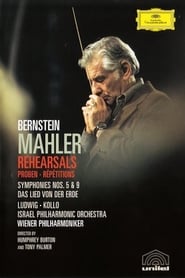
Bernstein Mahler Rehearsal
G 1976 · 54 min · ★ 7.0 · Music
"Four Ways to Say Farewell" is a personal introduction to Mahler and his Ninth Symphony, during which Leonard Bernstein is seen and heard rehearsing the Vienna Philharmonic Orchestra. Filmed in 1971, this rehearsal was directed by Humphrey Burton,
Directed by Humphrey Burton
Your Rating
Cast
-
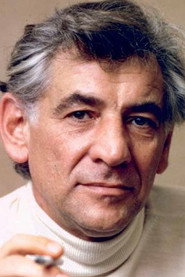 Leonard Bernstein Self - Conductor
-
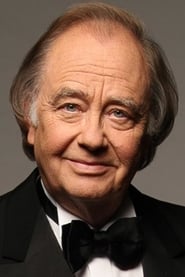 René Kollo Self
-
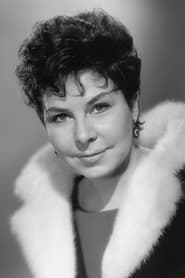 Christa Ludwig Self
- I Israel Philharmonic Orchestra Self - Orchestra
- V Vienna Philharmonic Self - Orchestra
Make it a double feature
2h 39m together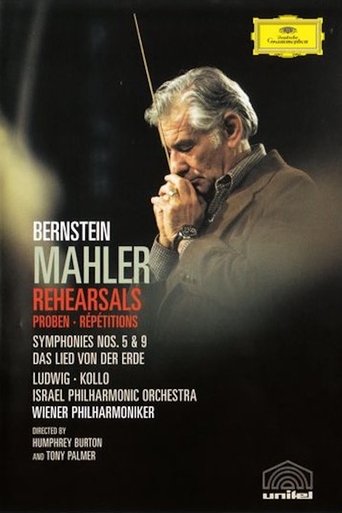
Both from Humphrey Burton.
More from Humphrey BurtonSee all →
 Bernstein in Vienna: Beethoven, The Ninth Symphony · 1970
Bernstein in Vienna: Beethoven, The Ninth Symphony
★ 10.01970
MovieMusic
To play Beethoven's music is to give oneself over completely to the child-spirit which lived in that grim, awkward, violent man. Without that utter submission it is impossible to play the Adagio of the Ninth. Or, Heaven knows, the first movement. And the Finale? Most of all! It is simply unplayable unless we go all the way with him, as he cries out "Brüder!" - Leonard Bernstein
 BBC Young Musician · 1978
BBC Young Musician
★ 10.01978
SeriesReality
BBC Young Musician (Young Musician of the Year) first appeared on our TV screens in 1978. The brainchild of BBC producers Humphrey Burton, Walter Todds and Roy Tipping, the biennial competition has developed an enviable reputation for finding superstar musicians including Nicola Benedetti, Mark Simpson and Sheku Kanneh-Mason.
 The Unanswered Question IV : The Delights and Dangers of Ambiguity · 1976
The Unanswered Question IV : The Delights and Dangers of Ambiguity
★ 9.01976
MovieDocumentaryMusic
This series comprised six lectures on music, which cumulatively took the title of a work by Charles Ives, The Unanswered Question. Bernstein drew analogies to other disciplines, such as poetry, aesthetics, and especially linguistics, hoping to make these lectures accessible to an audience with limited or no musical experience, while maintaining an intelligent level of discourse: Bernstein provides two distinct meanings of the term ambiguity. The first is "doubtful or uncertain" and the second, "capable of being understood in two or more possible senses"
 The Unanswered Question III : Musical Semantics · 1976
The Unanswered Question III : Musical Semantics
★ 9.01976
MovieDocumentaryMusic
This series comprised six lectures on music, which cumulatively took the title of a work by Charles Ives, The Unanswered Question. Bernstein drew analogies to other disciplines, such as poetry, aesthetics, and especially linguistics, hoping to make these lectures accessible to an audience with limited or no musical experience, while maintaining an intelligent level of discourse:Semantics is the study of meaning in language, and Bernstein's third lecture, "musical semantics", accordingly, is Bernstein's first attempt to explain meaning in music. Although Bernstein defines musical semantics as "meaning, both musical and extramusical" this lecture focuses exclusively on the "musical" version of meaning.
 Beethoven's Birthday: A Celebration in Vienna with Leonard Bernstein · 1970
Beethoven's Birthday: A Celebration in Vienna with Leonard Bernstein
★ 9.01970
MovieDocumentaryMusic
In this documentary portrait prepared for the anniversary of Ludwig Van Beethoven's 200th birthday, Leonard Bernstein illustrates his analysis with excerpts from his performances of Beethoven's Piano Concerto No. 1 in C Major and the Ode to Joy from the Ninth Symphony.
 The Unanswered Question I : Musical Phonology · 1976
The Unanswered Question I : Musical Phonology
★ 9.01976
MovieDocumentaryMusic
This series comprised six lectures on music, which cumulatively took the title of a work by Charles Ives, The Unanswered Question. Bernstein drew analogies to other disciplines, such as poetry, aesthetics, and especially linguistics, hoping to make these lectures accessible to an audience with limited or no musical experience, while maintaining an intelligent level of discourse: Phonology is the linguistic study of sounds, or phonemes. Bernstein's application of this term to music results in what he calls "musical phonology".
 Candide · 1988
Candide
★ 9.01988
MovieMusic
Candide falls in love with the beautiful but materialistic Cunegonde. Her barron father doesn't approve of the affair so Candide wanders, meeting all the misfortunes along the way.
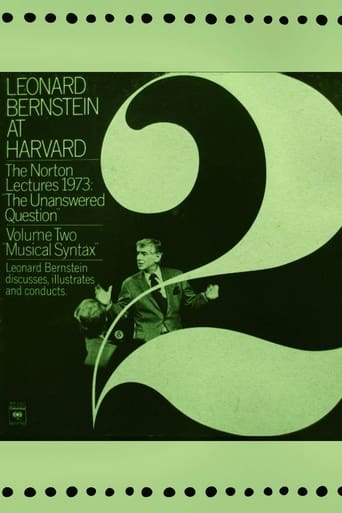 The Unanswered Question II : Musical Syntax · 1976
The Unanswered Question II : Musical Syntax
★ 9.01976
MovieDocumentaryMusic
This series comprised six lectures on music, which cumulatively took the title of a work by Charles Ives, The Unanswered Question. Bernstein drew analogies to other disciplines, such as poetry, aesthetics, and especially linguistics, hoping to make these lectures accessible to an audience with limited or no musical experience, while maintaining an intelligent level of discourse: Syntax refers to the study of the structural organization of a sentence, or as Bernstein summarizes, "the actual structures that arise from that phonological stuff."
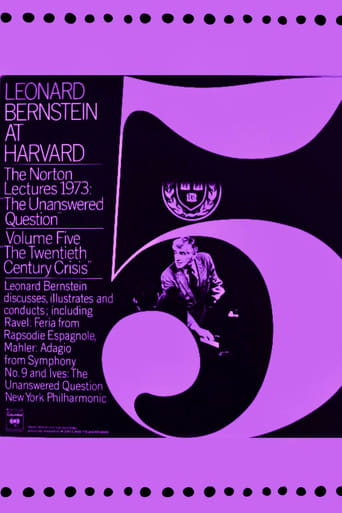 The Unanswered Question V : The Twentieth Century Crisis · 1976
The Unanswered Question V : The Twentieth Century Crisis
★ 8.51976
MovieDocumentaryMusic
This series comprised six lectures on music, which cumulatively took the title of a work by Charles Ives, The Unanswered Question. Bernstein drew analogies to other disciplines, such as poetry, aesthetics, and especially linguistics, hoping to make these lectures accessible to an audience with limited or no musical experience, while maintaining an intelligent level of discourse: Lecture 5 picks up at the early twentieth century with an oncoming crisis in Western Music. As these lectures have traced the gradual increase and oversaturation of ambiguity, Bernstein now designates a point in history that took ambiguity too far.
 Die Fledermaus · 1984
Die Fledermaus
★ 8.21984
MovieComedyMusic
Most opera houses ring in the New Year with Johann Strauss Jr.'s most popular operetta--the festiveness of which is appropriate for the occasion--and this December 31, 1983, Covent Garden performance follows suit. An exceptional cast--led by Hermann Prey and Kiri Te Kanawa as the couple whose marriage survives the comic indiscretions of three long acts--obviously has as much fun as the audience. Plácido Domingo leads the Orchestra of the Royal Opera House through its paces with panache. Prince Orlofsky's Act II party is always a splendid opportunity to pull out all the stops with surprise "guests," and this performance makes the most of its chance: entering the proceedings to sing one of his tailor-made chansons, "She," is French crooner Charles Aznavour, who is followed by dancers Merle Park and Wayne Eagling, their delightful pas de deux flashily choreographed by Sir Frederick Ashton.
 The Making Of West Side Story · 1985
The Making Of West Side Story
★ 8.21985
MovieDocumentaryMusic
A documentary which shows, in great detail, the making of the 1985 Bernstein-conducted recording of the entire score of "West Side Story", featuring operatic stars.
 The Little Drummer Boy: An Essay on Mahler by Leonard Bernstein · 1985
The Little Drummer Boy: An Essay on Mahler by Leonard Bernstein
★ 8.01985
MovieDocumentary
This television essay from 1985 was written by Leonard Bernstein to commemorate the 125th anniversary of Gustav Mahler's birth. Recorded in Israel, Vienna and later in London, it is punctuated by biographical interludes and illustrated by musical examples drawn from the cycle of Mahler's works recorded by Bernstein. Bernstein talks, plays and conducts various orchestras (Israel Philharmonic Orchestra, London Philharmonic Orchestra, Wiener Philharmoniker) and soloists (Janet Baker, Christa Ludwig, Edith Mathis, Lucia Popp, Walton Groenroos) in performances spanning 17 years. Leonard Bernstein also examines the roots of Gustav Mahler's inspiration. The programme also features music from the nine symphonies, 'The Song of the Earth' and the 'Wunderhorn Cycle'.
 Bernstein/Beethoven · 1982
Bernstein/Beethoven
★ 8.01982
SeriesDocumentary
A music miniseries, filmed largely on location in Vienna and Germany, not only featuring Bernstein but also, noted actor Maximilian Schell, who not only provided commentary on Beethoven, but read from his letters.
The miniseries contains performances of all of Beethoven's symphonies as well as several overtures, a string quartet that Bernstein re-orchestrated for the entire string section of the Vienna Philharmonic, and the Missa Solemnis, all conducted by Bernstein. It also contains commentary about the music by Leonard Bernstein.
 Boris Godunov · 1990
Boris Godunov
★ 7.31990
MovieMusic
This is the Andrei Tarkovsky production of the famous Pushkin/Mussorgsky opera, performed in 1990. Modest Mussorgsky's opera in prologue and four acts is performed by the Kirov Opera with performances from Olga Borodina, Alexei Steblianko and Sergei Leiferkust. Boris Godunov has obtained the throne of Russia by murdering the rightful heir Dmitry. An old monk, Pimen, witnessed this, and convinces his apprentice Grigory to avenge Dmitry's death. In the following years Grigory poses as Dmitry, raising an army against Boris, who is now convinced that he is being punished for the murder. Filmed in Russia during the collapse of the Soviet Union, this particular production of Mussorgsky's 1872 tale of political upheaval is considered a highly unique and historical moment in opera. Robert Lloyd stars in the title role of Boris Godunov.
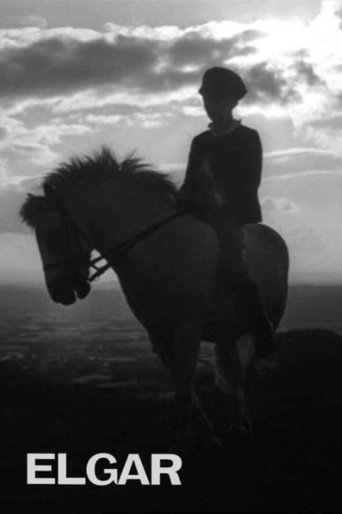 Elgar · 1962
Elgar
★ 7.11962
MovieDramaDocumentary
An astonishing documentary of the life of classical composer Sir Edward Elgar. This partly dramatised account is remarkable for its sensitive portrayal of the rise of a young musician from an underprivileged background to international fame.
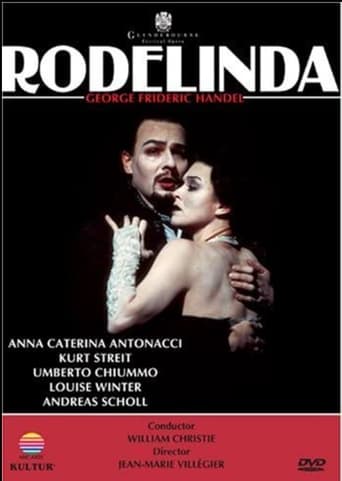 Rodelinda · 1998
Rodelinda
★ 7.01998
MovieMusicRomance
Jean-Marie Villegier's modern interpretation of Handel's "Rodelinda" – filmed live at the world-renowned Glyndebourne Opera House in the United Kingdom, sets the timeless tale of jealousy and treachery in the black-and-white world of the silent-movie era. Soprano Anna Caterina Antonacci sings the title role of Rodelinda, with tenor Kurt Streit and bass Umberto Chiummo performing the parts of Grimoaldo and Garibaldo, respectively.
More Like This
Couldn't load this row right now.