Rosa la China

Rosa la China

2002 · 109 min · ★ 4.8

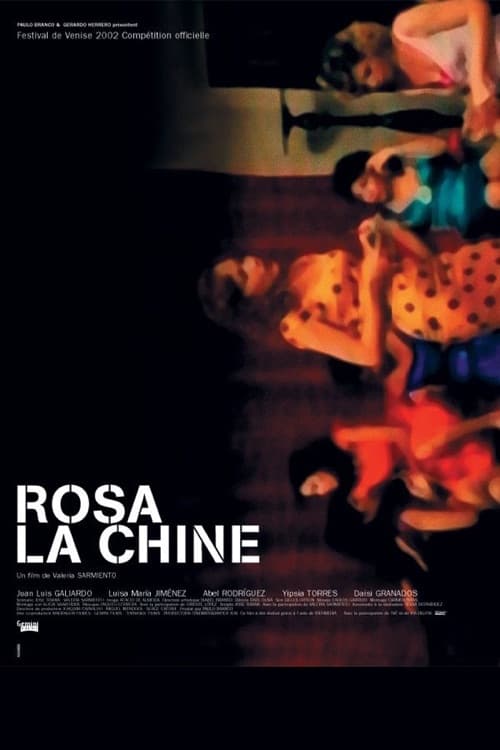
Chilean director Valeria Sarmiento weaves a tale of love, betrayal, and civil unrest centering around a nightclub in 1950s pre-Communist Cuba in her 2002 romantic drama Rosa La China. Notorious businessman Santiago Ordenez (Juan Luis Galiardo), who primarily goes by the nickname Dulzara, operates a high-profile club/casino with the protection of some local politicians with whom he has dubious relationships. A large portion of the club's success is due to its star singer, Rosa (Luisa Maria Jiminez), who also happens to be Dulzara's lover. Rosa, however, has recently started into another affair with a somewhat younger womanizer named Marcos (Abel Rodriguez).

Directed by Valeria Sarmiento

Your Rating

Cast

Make it a double feature

3h 52m together
Rosa la China
Love Torn in a Dream

Both from Valeria Sarmiento.

More from Valeria SarmientoSee all →
The One-Eyed ManThe One-Eyed Man · 1980
The One-Eyed Man
9.01980
MovieDrama
With his body now devoid of substance and able to fly, N. wanders looking for a way to return to life and reintegrate into the world.
Dans un miroirDans un miroir · 1986
Dans un miroir
9.01986
Movie
A man comes to visit an acquaintance who is supposed to be sick and talks to his sister while he is waiting.
Love Torn in a DreamLove Torn in a Dream · 2000
Love Torn in a Dream
7.82000
MovieDramaFantasy
A serious young man of free spirit is forced by his surroundings to become rich at all costs. A group of blind children tries to open the eyes of the unbelievers to the Christian faith. Retired nuns who open a brothel, to pay the running costs of the convent. These rather ironic paradoxes turn this fairytale into a philosophical fable.
Of Great Events and Ordinary PeopleOf Great Events and Ordinary People · 1980
Of Great Events and Ordinary People
7.51980
MovieDocumentary
In 1978, Ruiz was commissioned to make a television documentary about the French elections from the viewpoint of a Chilean exile in Paris’ eleventh arrondissement. But, contrary to the producers’ expectation, the Left lost. Ruiz seized on this anti-climax to make a documentary about nothing except itself – a film whose central subject is forever lost in digression and ‘dispersal’, harking back to his Chilean experiments of the ‘60s. Its political content is deliberately left negligible: it’s hard to tell at the end who did actually win the election, let alone why.
Mysteries of LisbonMysteries of Lisbon · 2010
Mysteries of Lisbon
7.22010
MovieDramaHistory
The tragic story of the many lives of Father Dinis, his dark origins and his pious works, and the different fates of all those who, trapped in a sinister web of love, hate and crime, cross paths with him through years of adventure.
Boucherie fineBoucherie fine · 1987
Boucherie fine
7.01987
MovieComedyDrama
A butcher whose meat is most tender, surrounded successively by ephemeral and delightful cashiers.
Brise-glaceBrise-glace · 1990
Brise-glace
6.61990
MovieDocumentary
Collaborative experimental project on which three director made different films about the Swedish icebreaker "Frej".
The Suspended VocationThe Suspended Vocation · 1978
The Suspended Vocation
6.61978
MovieDrama
The film centers on a Dominican monk named Jérôme (played by one actor in colour and another actor in black-and-white) and his interactions with various higher-ups within the French Catholic Church. Ruiz's intention was to reflect the ideological arguments that plagued Latin American left-wing political parties.
Genealogies of a CrimeGenealogies of a Crime · 1997
Genealogies of a Crime
6.51997
MovieCrimeDrama
An attorney defends a young man on trial for killing his aunt — a psychiatrist who took him in to study possible homicidal tendencies.
Mysteries of LisbonMysteries of Lisbon · 2011
Mysteries of Lisbon
6.52011
SeriesDrama
The tragic story of the many lives of Father Dinis, his dark origins and his pious works, and the different fates of all those who, trapped in a sinister web of love, hate and crime, cross paths with him through years of adventure and misfortune in the convulsed Europe of the late 18th and early 19th centuries. (A longer television version of the film of the same name, released in 2010.)
The Wandering Soap OperaThe Wandering Soap Opera · 2018
The Wandering Soap Opera
6.52018
MovieFantasyComedy
The film revolves around the concept of soap opera. Its structure is based on the assumption that Chilean reality does not exist, but rather is an ensemble of soap operas.
Treasure IslandTreasure Island · 1986
Treasure Island
6.41986
MovieDramaAdventure
Jim is a small child who lives in an inn run by his parents. The arrival of a strange captain to the Island they live will trouble his existence and tip him into an universe of adventures.
The Film to ComeThe Film to Come · 1997
The Film to Come
6.31997
Movie
If any single piece can act as a key to Ruiz, it may be the 1997 short Le Film à Venir (The Film to Come). The titular film is a holy fragment of celluloid that can only be seen by a secret society known as the Philokinetes. They watch it on a loop, somnambulating through a life that is unreal by comparison. It is the belief of the Philokinetes that film has an existence “independent from humans. Cinema, they said, is the primeval soup of a new life form. There from were to emerge pure screening creatures. Which is to say, non-topical beings.” - n+1
Nucingen HouseNucingen House · 2009
Nucingen House
6.32009
MovieHorror
Surreal gothic comedy about a gambler who wins a strange Chilean mansion and takes his frail wife there.
Brise-Glace: Histoires de glaceBrise-Glace: Histoires de glace · 1987
Brise-Glace: Histoires de glace
6.01987
MovieDramaFantasy
Third and final part of collaborative project Brise Glace. Directed by Raúl Ruíz.
Planet of the ChildrenPlanet of the Children · 1992
Planet of the Children
6.01992
MovieDocumentary
Documentary about Cuban education. El planeta de los niños is not a documentary and not a feature film. Sarmiento actually filmed a documentary subject with the mise-en-scène and the cutting of a feature film. Without further ado, she takes the viewer into a world where adults would appear to have died out ; a society within which all functions and professions are held by children with deadly seriousness as if things have always been this way. Only right at the end does Sarmiento reveal that she shot the film at the 'Escuele de Pioneros' set up in Cuba in 1979, an institution which Fidel Castro gave to the children of his people to prepare themselves for a later working life. The film opens with an as-good-as-real wedding ceremony and progresses via a birth to a simulated battle ; from birth to death. The subtle irony with which Sarmiento portrays this 'Utopian' world was not understood by all German critics.

More Like This

Couldn't load this row right now.
Rate this film

Your ratings make Midnight smarter