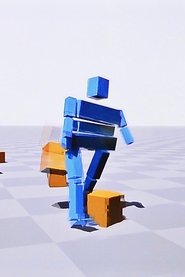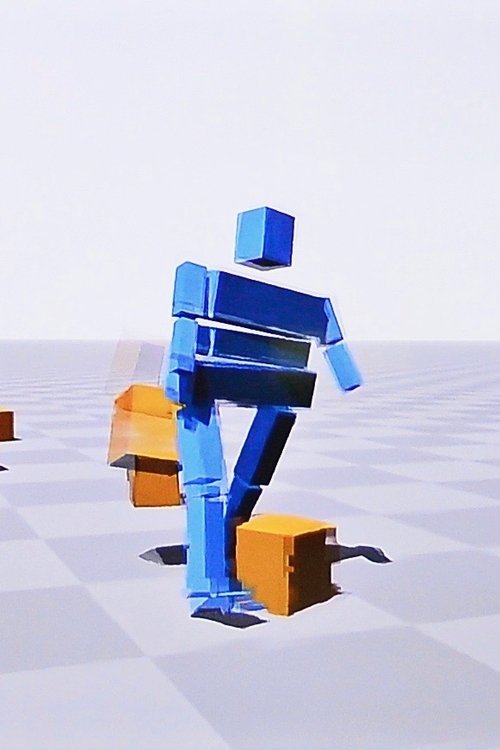
HellYeahWeFuckDie
2016 · 4 min
A three-channel video that begins with the animation of a fragmented sentence: HELL YEAH WE FUCK DIE—which, according to Billboard magazine, are the most frequently used five words in the English language music charts of the past decade. They provide the basis for the musical compositions that score documentary lab footage showing computer-simulated or actual physical force applied to humanoid robots to test their balance behavior.
Directed by Hito Steyerl
Your Rating
Make it a double feature
20m together
Both from Hito Steyerl.
More from Hito SteyerlSee all →
 How Not to Be Seen: A Fucking Didactic Educational .MOV File · 2013
How Not to Be Seen: A Fucking Didactic Educational .MOV File
★ 8.82013
MovieDocumentary
The film mocks an instructional film on the idea of becoming invisible in the digital world.
 Lovely Andrea · 2007
Lovely Andrea
★ 8.02007
MovieDocumentary
If all pictures became current, in that they pass by and in doing so, are connectable with one another, whether elegantly or obscenely, through translation or associationhow would it be possible to fasten down a picture? Hito Steyerls light-hearted picture translations are about fastening things in an elegant-obscene way: In Tokyo she is looking for a photo series that she posed for in 1987 as a rope bondage model. While making inquiries with experts and authorities in the bondage arts (which are mainly marketed online nowadays), she found what she was looking for in a magazine archive. The cinematic tension is extremely high just now says the translator while Steyerl looks through photos of herself from her days as a film student.
 November · 2004
November
★ 6.02004
MovieThriller
In the eighties, Hito Steyerl shot a feminist martial arts film on Super-8 stock. Her best friend Andrea Wolf played the lead role, that of a woman warrior dressed in leather and mounted on a motorcycle. The engagement expressed in the formal grammar of exploitation films later became Wolf’s political praxis: She went to fight alongside the PKK in the Kurdish regions between Turkey and northern Iraq, where she was killed in 1998. Now honoured by Kurds as an “immortal revolutionary,” her portrait is carried at demonstrations.
 Immortality and Resurrection For All! · 2017
Immortality and Resurrection For All!
★ 6.02017
MovieDocumentary
The last film in Vidokle's trilogy on Cosmism is a meditation on the museum as the site of resurrection-a central idea for many Cosmist thinkers, scientists and avant-garde artists. Filmed at the State Tretyakov Gallery, the Moscow Zoological Museum, The Lenin Library, and the Museum of Revolution, the film looks at museological and archival techniques of collection, restoration and conservation as a means of the material restoration of life, following an essay penned by Nikolai Federov on this subject in the 1880s. The film follows a cast comprised of present-day followers of Federov, several actors, artists and a Pharaoh Hound that playfully enact a resurrection of a mummy, a close examination of Malevich's Black Square, Rodchenko's spatial constructions, taxidermied animals, artifacts of the Russian Revolution, skeletons, and mannequins in tableau vivant-like scenes, in order to create a contemporary visualization of the poetry implicit in Federov's writings.
 The Communist Revolution Was Caused By The Sun · 2015
The Communist Revolution Was Caused By The Sun
★ 5.02015
MovieDocumentary
The second installment of Anton Vidokle’s trilogy on Russian cosmism, The Communist Revolution Was Caused By The Sun, looks at the poetic dimension of the solar cosmology of Soviet biophysicist Alexander Chizhevsky. Shot in Kazakhstan, where Chizhevsky was imprisoned and later exiled, the film introduces Сhizhevsky’s research into the impact of solar emissions on human sociology, psychology, politics, and economics in the form of wars, revolutions, epidemics, and other upheavals. It aligns the life of post-Soviet rural residents and the futurological projects of Russian cosmism to emphasize that the goal of the early Soviet breakthroughs aimed at the conquest of outer space was not so much technical acceleration, but the common cause of humankind in their struggle against the limitations of earthly life.
 This Is Cosmos · 2014
This Is Cosmos
2014
MovieDocumentary
Based on the ideas of Russian philosopher, Nikolai Fedorov, Anton Vidokle’s film was shot in Siberia, Crimea, and Kazakhstan. Fedorov, like others, believed that death was a mistake, “because the energy of cosmos is indestructible, because true religion is a cult of ancestors, because true social equality is immortality for all.” Fedorov was one of the Cosmo-Immortalists, a surge of thinkers that emerged in Russia in the late 19th and early 20th centuries. They linked Western Enlightenment with Russian Orthodoxy and Eastern philosophical traditions, as well as Marxism, to create an idiosyncratically concrete metaphysics. For the Russian cosmists, cosmos did not mean outer space: rather, they wanted to create “cosmos” on earth. “To construct a new reality, free of hunger, disease, violence, death, need, inequality – like communism.”
 Abstract · 2012
Abstract
2012
MovieHistoryDocumentary
Abstract (2012) is a return to the contested narrative of Andrea Wolf’s death, with Steyerl traveling to Kurdistan in search of information about her friend's murder. The work links cinematic shooting and military warfare together, implicating Germany’s role in the operation. This has been screened in the past as a dual-channel work. But in this case it has been re-purposed by the artist as a split screen film. (KG) From e-flux:
Abstract presents a scenario in which the violence of warfare and the violence of aesthetics twist around each other. The two-channel video visits the site where Steyerl’s friend Andrea Wolf was killed in 1998, but through a prism that refracts cinematic language against the weapons that killed her friend. As the site and circumstances of her death fold into the act of witnessing it from a distance, the ethical burden of identifying those responsible also appears to live and die with the debris that still remains at the site of the helicopter attack.
 Liquidity Inc. · 2014
Liquidity Inc.
2014
MovieScience Fiction
Liquidity Inc. takes up liquidity as a concept in all of its physical, metaphorical, bodily, spiritual, meteorological, and financial forms
 Universal Embassy · 2004
Universal Embassy
2004
Movie
A short documentary about the Universal Embassy. After the collapse of the Somali government twenty years ago, its embassy in Brussels was left empty. The embassy and the sovereignty of the grounds were claimed by a group of activists who planted their own flag. This former piece of ‘Somalia’ is the only place on earth that does not belong to a country. The documentary shows how a group of people without a residence permit must live. The Universal Embassy is devoted to the cause of other homeless people, the sans papiers.
 The Empty Center · 1998
The Empty Center
1998
MovieDocumentary
Steyerl’s film traces the impact of an influx of transnational companies on the city dwellers of Berlin in post-reunification Germany. The effect of the changing economy and politics on the city and its inhabitants is echoed through their physical relocation to its outer edges. In 1990, squatters proclaim a socialist republic on the death strip. Eight years later, the new headquarters of Mercedes Benz are built in the same location. The film makes use of slow super-impositions to uncover a journey across changing architectural and cultural boundaries. "The Empty Centre" tries to give a voice and a history to those who continue to be marginalised by the simultaneous dismantling and reconstruction of the borders which they are trying to cross.
 Leibnitz' Skull · 2012
Leibnitz' Skull
2012
Movie
The exhibition „Mengele's Skull“ is structured around a specially commissioned book of the same title co-authored by Thomas Keenan and Eyal Weizman. Artist and filmmaker Hito Steyerl has been commissioned to respond to the proposition laid out in this book. Next to major new works by Hito Steyerl, this exhibition presents documentary and source materials.
 Guards · 2012
Guards
2012
Movie
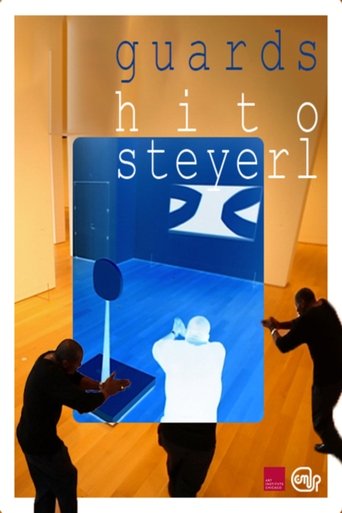
A film about museum guards with a background as law enforcement officers or military personnel.
 Factory of the Sun · 2015
Factory of the Sun
2015
Movie
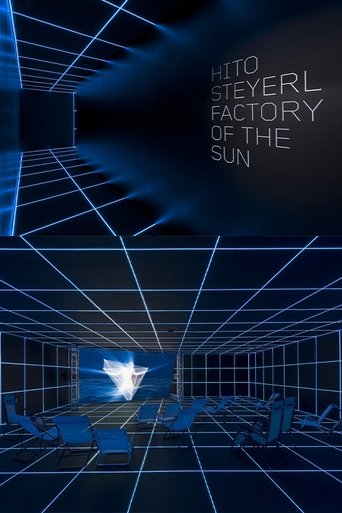
In this immersive work, which debuted at the 2015 German Pavilion at the Venice Biennale, Steyerl probes the pleasures and perils of image circulation in a moment defined by the unprecedented global flow of data. Ricocheting between genres—news reportage, documentary film, video games, and internet dance videos—Factory of the Sun uses the motifs of light and acceleration to explore what possibilities are still available for collective resistance when surveillance has become a mundane part of an increasingly virtual world. Factory of the Sun tells the surreal story of workers whose forced moves in a motion capture studio are turned into artificial sunshine.
 Drill · 2019
Drill
2019
MovieDocumentary
Hito Steyerl reveals her most recent installation in the U.S. to date, commissioned by the Armory and curated by Park Avenue Armory’s visual arts curator Tom Eccles. Steyerl utilizes both the Wade Thompson Drill Hall and historic interiors of the building in mounting both pre-existing works as well as new projects commissioned by the Armory in her ongoing illumination of the world’s power structures, inequalities, obscurities, and delights. When viewed collectively, this material allows the viewer to zoom in on and out from some of the most complex and pressing issues of our time.
 This Is The Future · 2019
This Is The Future
2019
Movie
As part of an art installation, Steyerl uses AI technology to create a garden of the future that emulates the Venetian landscape of elevated walkways. Viewers walk among digital flowers that cycle through their lifespan without ever actually existing. Through Steyerl’s self-created technology, she asks whether AI can successfully predict the future, the answer being an explicit ‘no’.
 Strike · 2010
Strike
2010
Movie
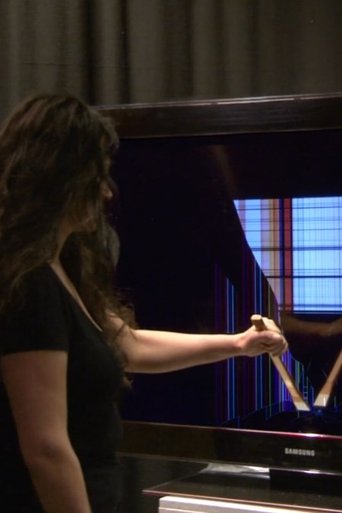
It begins with a blank screen. The word ‘STRIKE’ appears across it, in white capital letters against a black background. Then a woman appears, dressed in black. She approaches an empty LCD monitor and strikes its undifferentiated surface once with a chisel, leaving a multi-coloured web of fractures across it, before everything fades (back) to black. It’s all over in less than 30 seconds. Then it starts again.
More Like This
Couldn't load this row right now.