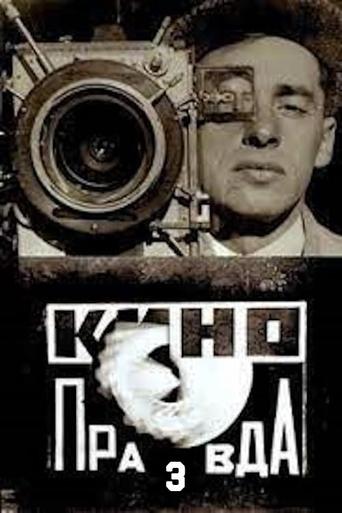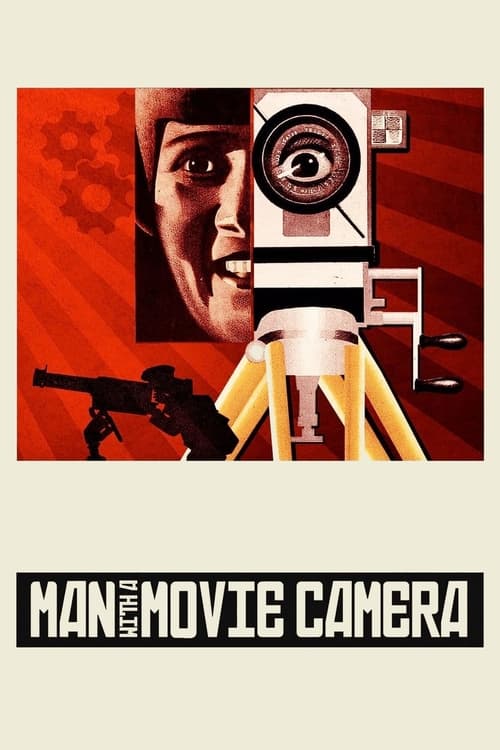
Man with a Movie Camera

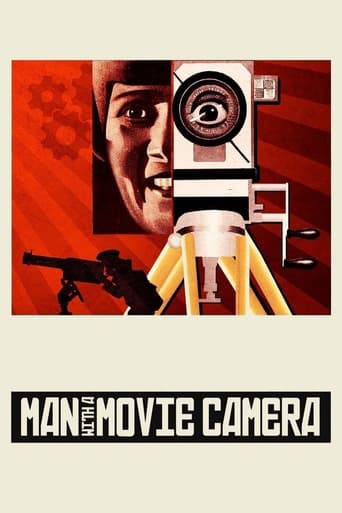
Man with a Movie Camera

The Greatest Documentary Ever Made

1929 · 68 min · ★ 7.8 · Documentary

A cameraman wanders around with a camera slung over his shoulder, documenting urban life with dazzling inventiveness.

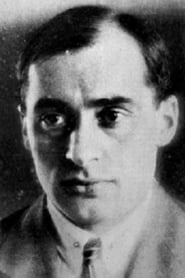
Directed by Dziga Vertov · Written by Dziga Vertov

Your Rating

Cast

More from Dziga VertovSee all →

Three HeroinesThree Heroines · 1938
Three Heroines
9.51938
MovieDocumentary
Follows the legendary female pilots Raskova, Osipenko, and Grisodubova in their failed but magnificent attempt to make the first nonstop trans-Siberian flight. Using documentary reenactments, Vertov depicts the flight, the crash, the rescue, and the women’s heroic return to Moscow, where crowds shower them with flowers, and leaders with speeches.
Anniversary of the RevolutionAnniversary of the Revolution · 1918
Anniversary of the Revolution
6.81918
MovieDocumentaryHistory
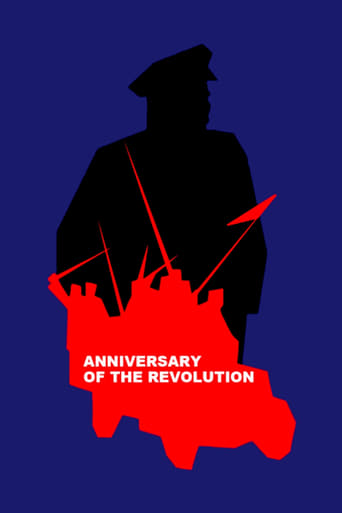
A chronicle of the Russian Revolution of 1917, from the bourgeois democratic February Revolution to the great socialist October Revolution and the final triumph.
A Sixth Part of the WorldA Sixth Part of the World · 1926
A Sixth Part of the World
6.61926
MovieDocumentary
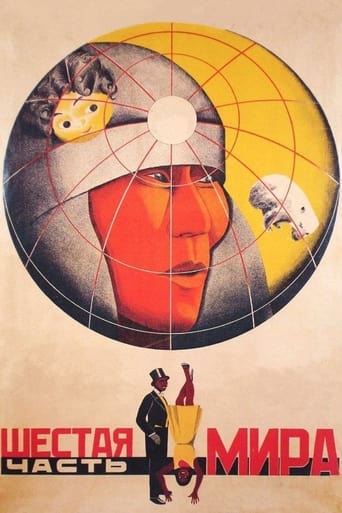
Through the travelogue format, it depicts the multitude of Soviet peoples in remote areas of USSR and details the entirety of the wealth of the Soviet land. Focusing on cultural and economic diversity, the film is in fact a call for unification in order to build a "complete socialist society".
Kino-Pravda No. 16: Spring Pravda. A Lyrical View NewsreelKino-Pravda No. 16: Spring Pravda. A Lyrical View Newsreel · 1923
Kino-Pravda No. 16: Spring Pravda. A Lyrical View Newsreel
6.21923
MovieDocumentary
Dziga Vertov-directed Soviet newsreel covering: Arts and crafts exhibition / Actions against hunger / Eisenstein's first film "Dnevnik Glumova" ("Glumov's Diary") / Young Pioneers / May 1, parades
Stride, Soviet!Stride, Soviet! · 1926
Stride, Soviet!
6.21926
MovieDocumentary
Commissioned by the Moscow Soviet as a documentary and information film for the citizens of Moscow prior to municipal elections, film is a tableau of Soviet life and achievements in the period of reconstruction following the Civil War of 1917-1921.
Lluvia de jaulasLluvia de jaulas · 2019
Lluvia de jaulas
6.12019
MovieDocumentary
Popular neighborhoods that are open-air prisons. Where beauty flirts with violence. The kingdom of the insubordinate children, veterans of the lead. A garden of amputated flowers, which with crutches on their backs, still grow and dance.
Kino-Pravda No. 18: A Movie-Camera Race Over 299 Metres and 14 Minutes and 50 Seconds in the Direction of Soviet RealityKino-Pravda No. 18: A Movie-Camera Race Over 299 Metres and 14 Minutes and 50 Seconds in the Direction of Soviet Reality · 1924
Kino-Pravda No. 18: A Movie-Camera Race Over 299 Metres and 14 Minutes and 50 Seconds in the Direction of Soviet Reality
5.91924
MovieDocumentary
Dziga Vertov-directed Soviet newsreel covering: Up the Eiffel Tower in Paris / Moscow / Auto race Petrograd – Moscow / Aspects of everyday Soviet life / Peasant from Jaroslavl' visiting Moscow / Ceremonial introduction of a newborn into a workers' collective
The Brain of Soviet RussiaThe Brain of Soviet Russia · 1919
The Brain of Soviet Russia
5.91919
MovieDocumentary
This film shows the leaders of organizations that emerged after the Russian Revolution. It is the fragment of ‘Anniversary of the Revolution’ made by Vertov in 1918.
The Eleventh YearThe Eleventh Year · 1928
The Eleventh Year
5.91928
MovieDocumentary
The film is dedicated to the achievements of the Ukrainian SSR for the eleventh anniversary of the October Revolution.
Kino-Pravda No. 9Kino-Pravda No. 9 · 1922
Kino-Pravda No. 9
5.91922
MovieDocumentary
Dziga Vertov-directed Soviet newsreel covering: Congress of the "Living Church" / Opening of the horse racing season / Demonstration of an American movie camera / Operation of mobile projection units.
Kino-Pravda No. 8Kino-Pravda No. 8 · 1922
Kino-Pravda No. 8
5.81922
MovieDocumentary
Dziga Vertov-directed Soviet newsreel covering: A bet is placed on the outcome of the Trial of the Socialist Revolutionaries / The verdict / People in streetcars and on the street / A crashed aircraft / Reconstruction of streetcar line 13 / Peacetime use of tanks – airport construction work.
Kino-Pravda No. 14Kino-Pravda No. 14 · 1923
Kino-Pravda No. 14
5.61923
MovieDocumentary
Dziga Vertov-directed Soviet newsreel covering: IV. Congress of the Comintern / Congress of the Profintern.
Kino-Pravda No. 21: Lenin Kino-Pravda. A Film Poem About LeninKino-Pravda No. 21: Lenin Kino-Pravda. A Film Poem About Lenin · 1925
Kino-Pravda No. 21: Lenin Kino-Pravda. A Film Poem About Lenin
5.51925
MovieDocumentary
Dziga Vertov-directed Soviet newsreel made to commemorate the first anniversary of the death of Vladimir Ilich Lenin (21st January 1924 - 1925) drawn from 'The Final Journey', a Pravda feuilleton written on the occasion of Lenin's funeral by the man who had introduced Vertov to cinema, Mikhail Koltsov. Contains: First anniversary of Lenin's death: 1. Assassination attempt on Lenin and Soviet Russia's progress under his leadership / 2. Lenin's illness, death and funeral / 3. The year after Lenin's death
Kino-Pravda No. 1Kino-Pravda No. 1 · 1922
Kino-Pravda No. 1
5.51922
MovieDocumentary
Dziga Vertov-directed Soviet newsreel covering: Starving children / Requisitioning of valuables possessed by the Russian Orthodox Church / Fundraising flights in support of the hungry / Trial of the Socialist Revolutionaries.
Soviet ToysSoviet Toys · 1924
Soviet Toys
5.41924
MovieAnimationComedy
The first animated movie made in the Soviet Union, it portrays a bloated caricature of a Capitalist devouring a massive heap of food and drink.
Kino-Pravda No. 23: Radio PravdaKino-Pravda No. 23: Radio Pravda · 1925
Kino-Pravda No. 23: Radio Pravda
5.41925
MovieDocumentary
Dziga Vertov-directed Soviet newsreel covering: A peasant buys a receiver at the radio shop / Instructions to attach an antenna / A broadcast-station is developed / A concert is broadcast. Though only a third of this final issue of Kino-Pravda seems to survive, there still exists Aleksandr Bushkin’s time-lapse animation and the sequence in which, as Yuri Tsivian describes, “a cross-section of a photographically correct izba (Russian peasant’s log hut) is penetrated by schematically charted radio waves”—a testament to the magical properties and propagandistic uses of radio in reaching out to Russia’s distant peasantry.

More Like This

Couldn't load this row right now.
Rate this film

Your ratings make Midnight smarter