Make it a double feature

Both from Marie Menken.
More from Marie MenkenSee all →
 Bitch · 1965
Bitch
★ 8.01965
Movie
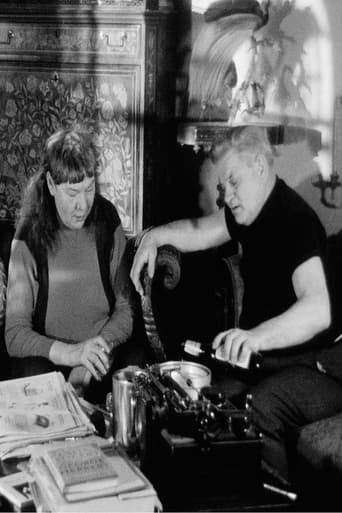
“Andy Warhol called Marie Menken and Willard Maas ‘the last of the great bohemians,’ and, in 1965, made Bitch, his real-life parody of Edward Albee’s play Who’s Afraid of Virginia Woolf?, with Willard and Marie sitting on the couch in their living room, drunk and arguing on a Sunday afternoon. Unscripted, shot with a stationary camera in his signature home-movie documentary style, Warhol’s Bitch has never before been seen by the public—until now…” (Philip Gefter).
 Moonplay · 1962
Moonplay
★ 7.01962
Movie
An expansion upon an idea put forward in Marie Menken's film Notebook; single-frame footage of the moon shot on various nights, blinking and darting around within Menken's field of vision.
 Dionysus · 1964
Dionysus
★ 7.01964
Movie
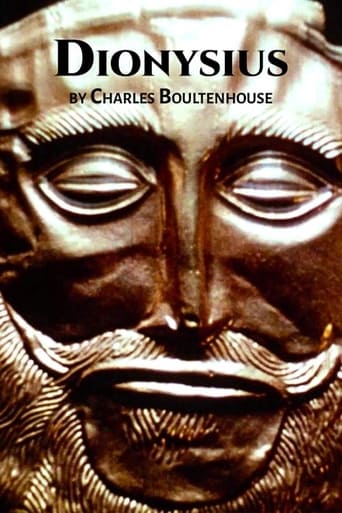
In 1963 Boultenhouse wrote, produced, and directed Dionysius,which he described as a “free treatment of Euripides' The Bacchae.”It starred the dancers Louis Falco, Anna Duncan, and Nicolas Magallanes as Dionysius, Agave, and Pentheus respectively, and the experimental filmmakers Charles Levine, Willard Maas, Gregory Markopoulos, Marie Menken, Lloyd Williams and William Wood as the Chorus of Cameras. The film's score was by Teiji Ito.
 The Life of Juanita Castro · 1965
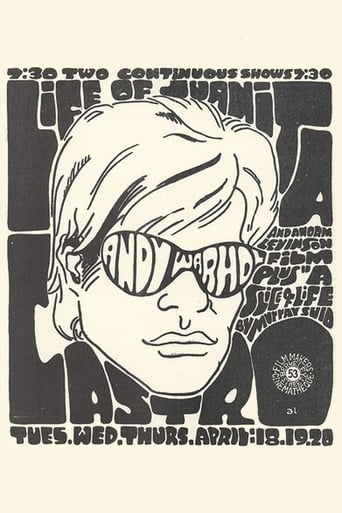
The Life of Juanita Castro
★ 6.91965
MovieComedy
A playwright taunts a number of actors into improvising a truly ridiculous but subtlely meaningful meditation on Fidel Castro and his family.
 Go! Go! Go! · 1964
Go! Go! Go!
★ 6.31964
MovieDocumentary
Various forms of everyday motion in and around a city are shown at rapid speed.
 Hurry, Hurry! · 1957
Hurry, Hurry!
★ 6.31957
Movie
In this strange little film, Marie Menken photographs billowy flames superimposed over microscopic medical footage of writhing spermatozoa.
 Visual Variations on Noguchi · 1945
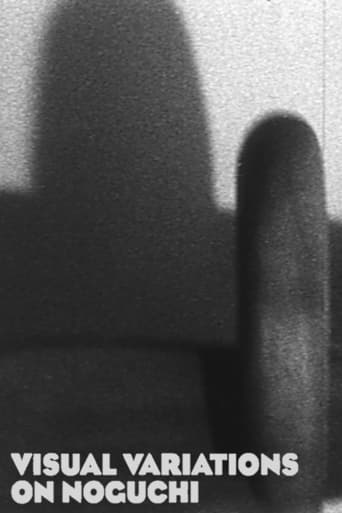
Visual Variations on Noguchi
★ 6.21945
Movie
A voice occasionally says a word or two: "on the sidewalk" or "lithium" or a woman's name. A hand-held camera frames parts of sculptures, or moves across their surfaces, sometimes slowly, sometimes quickly, almost always in close-up. The soundtrack, in addition to the voice, is discordant music. Light and shadows are paramount. Sometimes the camera repeats up and down movements; once, a set of jump cuts brings an object closer. The music can be shrill in contrast to the sculptures. Almost entirely of wood, they are the work of Isamu Noguchi (1904-1988): Abstract, usually smooth and rounded (but not always).
 Arabesque for Kenneth Anger · 1961
Arabesque for Kenneth Anger
★ 5.71961
MovieDocumentary
Filmed at the Alhambra in Spain in just one day, according to Marie Menken. Arabesque for Kenneth Anger concentrates on visual details found in Moorish architecture and in ancient Spanish tile. The date 1961 refers to the addition of Teiji Ito's soundtrack and its subsequent completion, but the film was likely shot in 1960 or earlier. - David Lewis
 Lights · 1966
Lights
★ 5.61966
Movie
Shot over a period of three years. Marie Menken photographed New York window displays during the Christmas holiday. In order to avoid foot and street traffic interrupting the shots, Menken filmed from midnight to 1:00 in the morning, but had to keep the camera under her coat to keep it from freezing.
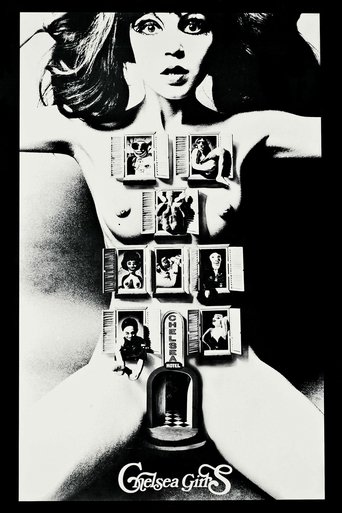 Chelsea Girls · 1966
Chelsea Girls
★ 5.51966
MovieDrama
Follows various residents of the Chelsea Hotel in 1966 New York City.
 Glimpse of the Garden · 1957
Glimpse of the Garden
★ 5.51957
MovieDocumentary
Experimental film showing film clips of a garden, with birds chirping for the soundtrack.
 Notebook · 1963
Notebook
★ 5.51963
Movie
A short, diaristic film; A series of impressions, animations and playful vignettes in color and B&W. Early/ Outtake footage of Menken's Lights can be seen here, as well as camera techniques she'd expand upon in later films.
 Eye Music in Red Major · 1961
Eye Music in Red Major
★ 5.41961
Movie
"A study in light based on persistence of vision and enhancement from eye fatigue." -- M.M.
 The Geography of the Body · 1943
The Geography of the Body
★ 5.21943
MovieDocumentary
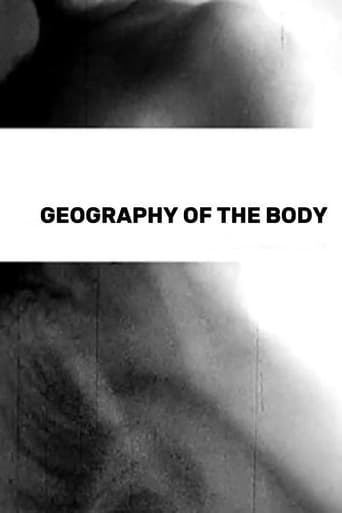
A quotation from Aristophanes, "The desire and pursuit of the whole is called love," precedes views of a man and a woman's bodies, often in extreme close up. Off-screen, a voice recites fragments of oracular literature and purple prose. We see an eye, an ear, a mouth, a tongue, bits of hair, a hand, the tips of fingers, toes. Occasionally, the frame includes a larger scape of a body: a chest, a back, a breast. Usually the camera is stationery; sometimes, it moves across a body, remaining in close up. They hold hands for one moment. The bodies are without clothes; no genitalia are visible.
 Andy Warhol · 1965
Andy Warhol
★ 4.71965
MovieDocumentary
Andy Warhol is a lyrical exploration of Warhol's creative process by filmmaker, painter, and actress Marie Menken. Using a hand-held camera, Menken captures Warhol and his assistants, including Gerard Malanga, as they work at the Factory. The result is an intimate portrait of the artist in the process of creating some of his most famous works, including the Brillo boxes, the Jackie series, and the Flowers silkscreens.
 Watts with Eggs · 1967
Watts with Eggs
★ 3.01967
MovieAnimation
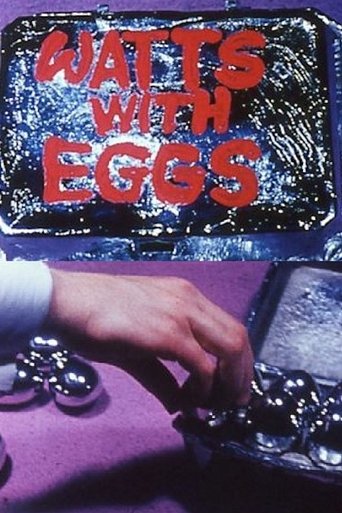
"By 1967, Menken had become interested in the work of Fluxus artist Robert Watts and made a short animation piece, Watts with EGGS, in which she animates his chrome-casted Box of Eggs. The film opens with lights reflected in the eggs (of course), then, through single framing, pixilates a man's hand arranging eggs in different patterns. The hands (those of John Hawkins) fill the box back up with eggs. Next, the eggs do the same routine, but more magically, more serenely, without the assistance of the hands. Menken also introduces a string and a feather duster into animated action, so that the eggs, one by one, seem to be coming directly out of the duster (objects infect objects). By the end, the eggs are magically back in their box." Melissa Ragona
More Like This
Couldn't load this row right now.