
Wolf-Zooming
1974 · 5 min
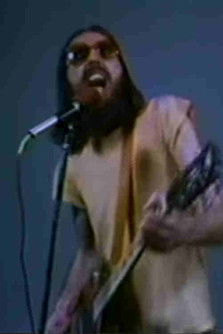
Repeating, erratic zooms on Gusella's face.
Directed by Ernest Gusella
Your Rating
More from Ernest GusellaSee all →
 The Commission · 1983
The Commission
1983
Movie
This work is Woody's first entry into the narrative sphere, whereby the "story" is continually undermined with the aid of various anti-narrative strategies: In each of the eleven segments of this "electronic opera", different effects are used. Fascinated with the remarkable personality of infamous violinist Niccola Paganini and his complicated relationship to Hector Berlioz (played by artists Ernie Gusella and Robert Ashley, respectively), the author meditates over the intricacies of artistic geniality as connected not only with fame but also with the necessity of painful survival under the pressures of the art market.
 Connecticut Papoose · 1981
Connecticut Papoose
1981
Movie
CONNECTICUT PAPOOSE is conceived a surrealist tract, with references to Lautremont, Tristan Tzara, Andre Breton and to surrealist images of sleeping and dreaming. Throughout the tape, unrelated images and ideas are juxtaposed as they might be in a surrealist painting by Magritte. The voice over operates as a kind of stream of consciousness guide through the underworld labyrinth of the human mind (with all its vicissitudes). Lines from poets are combined with skewed observations on contemporary culture. Performances of musical and artistic content coccur within abnormal contexts. Images and sounds themselves also distorted and manipulated by electronic processes to produce a distancing and alienation from reality.
 Vere D'he Go? · 1978
Vere D'he Go?
1978
Movie
A playful reference to vertigo in the title Vere d’he Go Composition announces a more vigorous attempt at spatial disorientation using again the striped sticks and now vertical wipes.
 Art Punks · 1978
Art Punks
1978
MovieMusic
Art Punks is a song directly attacking the antics of famous conceptual body artists of the day.
 Bending Diogenes · 1983
Bending Diogenes
1983
Movie
Bending Diogenes is a lamentation on modern "siphilization," with its promises and dreams for a bigger and better life. It questions modern man's motives and conditions, while introducing the teachings of Diogenes, the founder of the Cynic School of Philosophy, of ancient Greece.
 Iris · 1979
Iris
1979
Movie
An example of Gusella's impressive switch edits; A disarming rhythm is produced.
 Exquisite Corpse · 1978
Exquisite Corpse
1978
Movie
The "exquisite corpse" named in the title of this piece refers to a favorite game of the Surrealists, played by passing a folded sheet of paper among a group; each person draws one section of a body on the folded segment without looking at the other sides. What was done with pen and paper, Gusella accomplishes electronically using the VideoLab. Utilizing quick, voltage-controlled live switching between two cameras, Gusella approximates composite images. For examples, his torso appears to combine with a close-up of his face. The perceptual effect is mesmerizing and disorienting.
 No Commercial Potential (Collected Works 1974 - 1978) · 1978
No Commercial Potential (Collected Works 1974 - 1978)
1978
Movie
No Commercial Potential is composed of 19 separate video performance works. Each piece utilizes some aspect of video processing; From the playful to the aggressive, Gusella's early works in the medium are notable. The sounds are both natural (zoom lens being manipulated in 'Wolfzooming') and electronic, or a combination of both, as in the hypnotic 'Neo Plastic Key'.
 Playing Catch and Playing Catch Again · 1974
Playing Catch and Playing Catch Again
1974
Movie
Two early experiments from Ernest Gusella.
 Facial Treatments #2 and #4 · 1977
Facial Treatments #2 and #4
1977
Movie
Video art by Ernest Gusella made between 1975 and 1980
 What Under the Sun? · 1984
What Under the Sun?
1984
Movie
What Under The Sun? is a private view of Mexico and it's history up to the present, loosely based on Bernal Diaz's account of Cortez's Conquest of the Aztecs. The work was initiated by a desire to apply electronic stream of consciousness techniques, as utilized in previous works, to a more specific topic, in this case Mexican history. The work is composed of six chapters, each conveying some aspect of Mexico's history or its psyche.
 Dude Defending A Stare-Case · 1974
Dude Defending A Stare-Case
1974
Movie
A feedback homage to the works of Duchamp.
More Like This
Couldn't load this row right now.