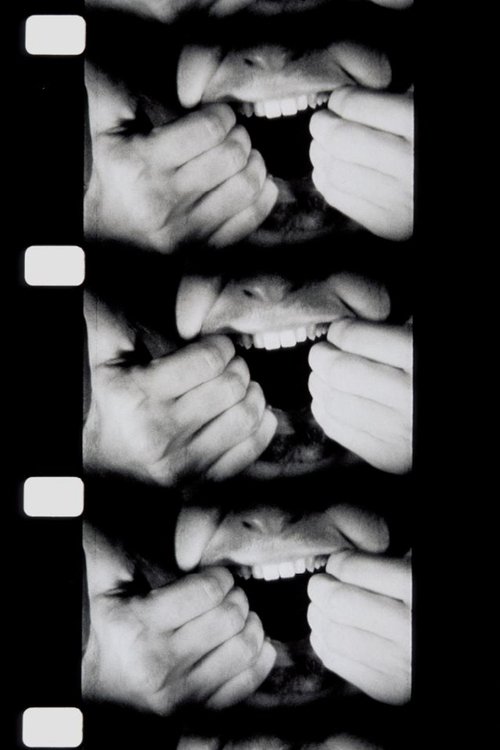
Pulling Mouth
8 min
This is one of the "Slo-Mo" series of films Nauman shot. Here he distorts his mouth with his fingers for the duration of the film in an inverted, close-up image.
Directed by Bruce Nauman
Your Rating
More from Bruce NaumanSee all →
 Seven Easy Pieces · 2007
Seven Easy Pieces
★ 2.02007
MovieDocumentary
For Seven Easy Pieces Marina Abramovic reenacted five seminal performance works by her peers, dating from the 1960's and 70's, and two of her own, interpreting them as one would a musical score. The project confronted the fact that little documentation exists from this critical early period and one often has to rely upon testimony from witnesses or photographs that show only portions of any given performance. The seven works were performed for seven hours each, over the course of seven consecutive days, November 9 –15, 2005 at the Guggenheim Museum, in New York City. Seven Easy Pieces examines the possibilities of representing and preserving an art form that is, by nature, ephemeral.
 Bouncing Balls · 1969
Bouncing Balls
1969
Movie
In this film, Nauman bounces his testicles with one hand. Shot in extreme close-up, the work is perhaps an ironic reference to an earlier film Bouncing Two Balls Between the Floor and Ceiling with Changing Rhythms, in which he bounced rubber balls. Along with Black Balls, Gauze, and Pulling Mouth, Bouncing Balls is one of Nauman's "Slo-Mo" films which are shot with an industrial high speed camera.
 Pinchneck · 1968
Pinchneck
1968
Movie
Experimental short by Bruce Nauman.
 No, No · 1987
No, No
1987
Movie
“Two color monitors placed in the window played one of Nauman’s most recent videos, that of a clown jumping up and down shouting ‘No, No, No, No!’ endlessly. Nauman’s videos confront the viewer with behavior normally thought unacceptable. The clown’s simple declarative statement takes on new meaning and creates tension and anxiety for the viewer.” The New Museum Annual Report, 1988
 Anthro / Socio · 1991
Anthro / Socio
1991
Movie
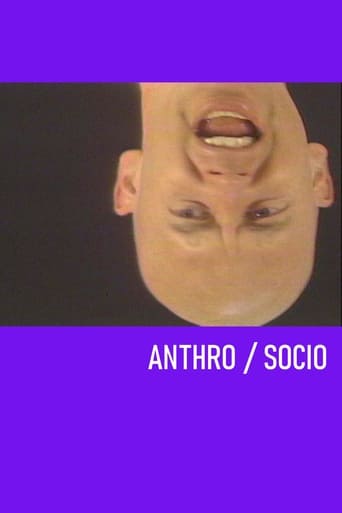
On three projection surfaces and six monitors, one sees the head of a man shown in different takes. While continually revolving about his own axis, in a variety of tonalities he sings «FEED ME/ EAT ME/ ANTHROPOLOGY,» «HELP ME/ HURT ME/ SOCIOLOGY,» and «FEED ME, HELP ME, EAT ME, HURT ME».
In order to grasp the full effect of the installation «Anthro/Socio,» the space has to be entered. The calls heard from different directions irritate as much as the contradictory demands, aimed at the simplest of bodily needs and questioning them at the same time. The repetition of the alarming singsong, and multiple video shots of the singer, also create a disturbing moment. In «Anthro/ Socio,» not only because of the all-encompassing sensual experience does the viewer become part of the artwork; the installation also encourages viewers to give thought to the inherent qualities of subjects and objects, and to human beings in society.
 The Bruce Nauman Story · 1968
The Bruce Nauman Story
1968
Movie
Creative portrait of the artist Bruce Nauman.
 Black Balls · 1969
Black Balls
1969
Movie
In this film, Nauman applies black makeup to his testicles. The action was recorded with an industrial high-speed camera capable of shooting between one thousand and four thousand frames per second.
 Good Boy Bad Boy · 1985
Good Boy Bad Boy
1985
Movie
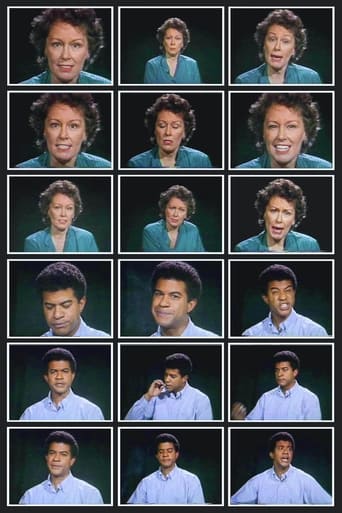
In the work two monitors are displayed at head height on pedestals. The head and shoulders of a young black man appear on one; on the other is an older white woman. They both speak the same sequence of a hundred phrases five times, beginning in a flat neutral tone, and becoming increasingly animated and intense until by the fifth recitation they appear very angry. Their techniques of delivery are quite different, and result in a slippage of time, so that played on a continuous loop, the two tapes become out of sequence.
 Flour Arrangements · 1967
Flour Arrangements
1967
Movie
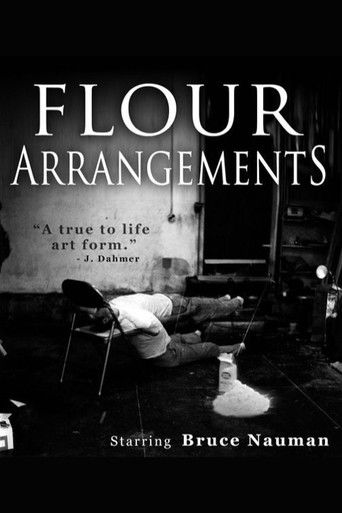
Flour Arrangements, a photo series showing Bruce Nauman pushing some piles of flour around on the floor. He uses his body by treating it like material for his art. Nauman committed himself to making one ephemeral flour sculpture each day for over a month.
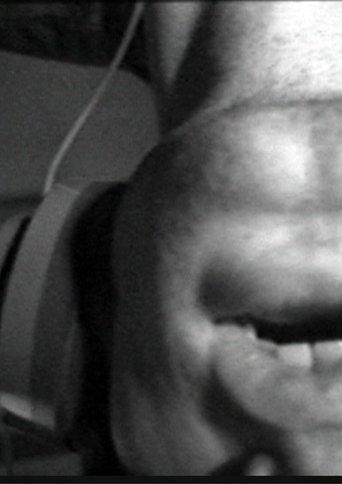 Lip Sync · 1969
Lip Sync
1969
Movie
An upside-down close-up of the artist’s mouth, Nauman repeats the words “lip sync” as the audio track shifts in and out of sync with the video. The disjunction between what is seen and heard keeps the viewer on edge, struggling to attach the sound of the words with the off-kilter movements of Nauman’s mouth.
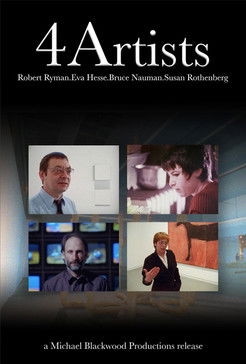 4 Artists: Robert Ryman, Eva Hesse, Bruce Nauman, Susan Rothenberg · 1988
4 Artists: Robert Ryman, Eva Hesse, Bruce Nauman, Susan Rothenberg
1988
Movie
4 Artists: Robert Ryman, Eva Hesse, Bruce Nauman, Susan Rothenberg acts as a collective portrait of creators linked only by their stated intention of expressing ideas through art. Unconnected to traditional concepts of beauty, storytelling or pictorial representation, the artists discuss the context of their art and how their work and the public's perception of it have changed over time. This film offers the rare opportunity to see a large body of work in their studios.—Michael Blackwood Productions
 Violent Incident: Man-Woman, Segment · 1986
Violent Incident: Man-Woman, Segment
1986
MovieFamily
In this video work Bruce Nauman explores violence, gender and behaviour. Set around a simple middle class dining table, the scene quickly escalates into a slapstick fight between a man and a woman. Their actions become increasingly more erratic and aggressive yet also ridiculous and cartoon-like as the video progresses. Nauman explores the ways in which anger can be provoked by others and questions the way we can react to them. Much like many of his other artworks, he employs the use of humour and exaggeration to explore serious and even dangerous topics - he produced this work as a result of his frustration with futile acts of violence in ordinary life. He explains, “The viewer is presented with a hypnotic repetition of pointlessly cruel and destructive violence which is both seductive and alienating.”
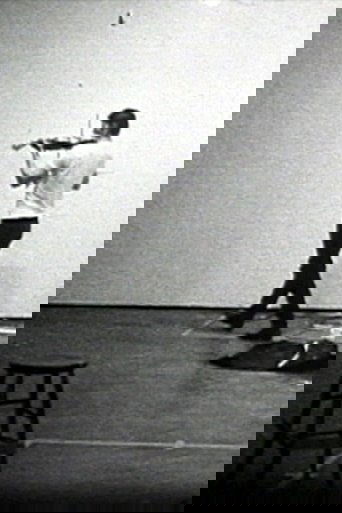 Playing a Note on the Violin While I Walk Around in the Studio · 1968
Playing a Note on the Violin While I Walk Around in the Studio
1968
Movie
In this film record of a studio activity, Nauman set himself the task of walking while playing "two notes [on a violin] very close together so that you could hear the beats in the harmonics." The camera is set centrally in the studio in a stationary position so that when he walks outside of the camera's view at times, only the sounds of the notes and footsteps are heard. Sound and image are out of sync, a situation noticeable only at the end of the film when the sound stops but Nauman continues to pace and play. [Overview Courtesy of Electronic Arts Intermix]
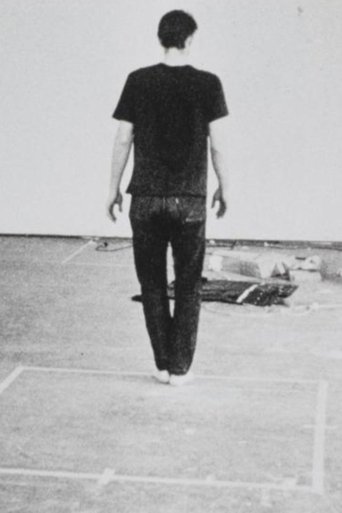 Dance or Exercise on the Perimeter of a Square · 1968
Dance or Exercise on the Perimeter of a Square
1968
Movie
Bruce Nauman - Dance or Exercise on the Perimeter of a Square (Square Dance) (1968), 16mm black-and-white film For this film, Bruce Nauman made a square of masking tape on the studio floor, with each side marked at its halfway point. To the sound of a metronome and beginning at one corner, he methodically moves around the perimeter of the square, sometimes facing into its interior, sometimes out.
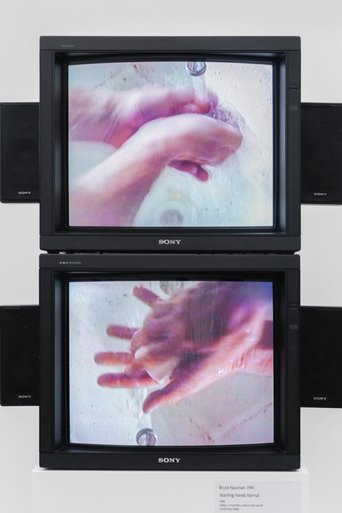 Washing Hands Normal · 1996
Washing Hands Normal
1996
Movie
This stacked two-screen video installation shows the artist washing his hands with a vigour that goes beyond a daily cleaning ritual. The energy of the gesture and the distortive effect of the double screen evoke a sinister prior event and a sense panic or fear. Here Nauman continues his ongoing investigation into human psychology and feelings of discomfort. The sense of anxiety is heightened by the echoing sound of the water draining away for the fifty-five-minute duration of the double footage.
 Violin Film #1 (Playing The Violin As Fast As I Can) · 1968
Violin Film #1 (Playing The Violin As Fast As I Can)
1968
MovieDocumentary
Violin Film #1 (Playing the Violin as Fast as I Can), is one of several 1967-68 films featuring Nauman's violin-playing, in which the production of sound is subjected to procedural strategies that problematize its status as music and performance.
More Like This
Couldn't load this row right now.
