M
Acting
Martin Zysset
No biography available.
Known For
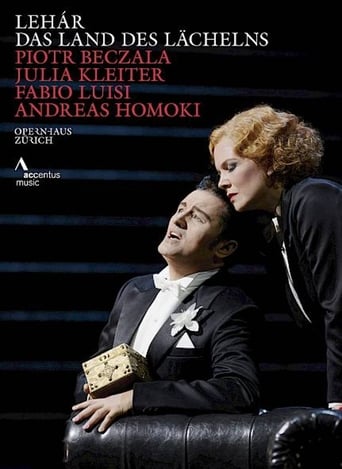 Das Land des Lächelns - Opernhaus Zürich · 2017
Das Land des Lächelns - Opernhaus Zürich
2017
MovieMusic
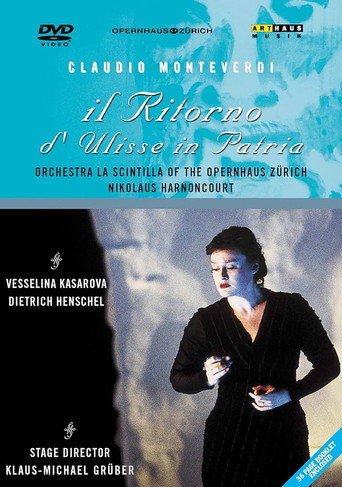 Claudio Monteverdi: il Ritorno d'Ulisse in Patria · 2002
Claudio Monteverdi: il Ritorno d'Ulisse in Patria
2002
MovieMusicFantasy
After ten years battling in the Trojan War—and another ten on an epic journey homeward—Ulysses returns to his homeland. Disguised as a beggar, the king of Ithaca must recover his wife, his son, and his people... Il ritorno d'Ulisse in patria (Venice, 1640), directed here by Klaus-Michael Grüber and conducted by Nikolaus Harnoncourt, achieves a perfect dramatic balance, stirring the imagination and instantly transporting the viewer to a long-ago time. The all-star cast features one of the earliest recorded appearances by the great Jonas Kaufmann, who makes his presence felt as Ulisse's son Telemaco.
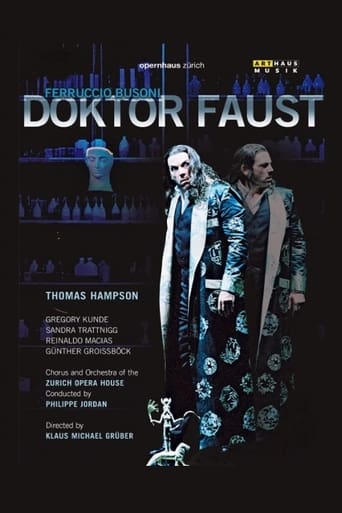 Doktor Faust · 2006
Doktor Faust
2006
MovieMusic
Faust - a lonely scholar, despairing of life, who has so far failed to discover its highest meaning - is given a book on black magic from three mysterious students from Cracow. When Mephistopheles appears and proposes a pact with Faust, the two of them set off together on a (dream) journey. Doktor Faust remained a fragment at the time of the composer's death. Busoni died in 1924, unable to complete what he himself described as his "state masterpiece" - an opera to which he had a deep personal attachment. The missing scenes from the score were completed by his pupil, Philipp Jarnach, whom Busoni had become acquainted with during his period in exile in Zurich. In this form the opera was given its first performance in Dresden in 1925. Then in the 1980s the conductor Anthony Beaumont came across previously undiscovered sketches by Busoni and produced a new version of Doktor Faust. The current recording uses the Jarnach score.
 Die Csárdásfürstin - Opernhaus Zürich · 2020
Die Csárdásfürstin - Opernhaus Zürich
2020
MovieMusic
Emmerich Kálmán’s Csárdásfürstin (The Gypsy Princess) was once one of the most popular works in the operetta repertoire, but has appeared only sporadically on the operatic stage in recent decades. The plot tells the story of a love triangle involving Sylva Varescu, a spirited variété artist of humble origin, and the aristocrat Edwin, who is already promised to another woman. The obstacle to their love is their difference in social status.
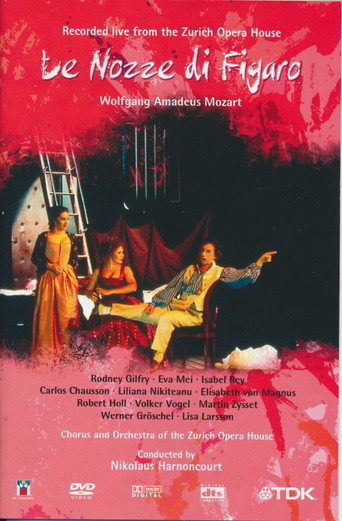 Le Nozze di Figaro · 1996
Le Nozze di Figaro
1996
MovieMusic
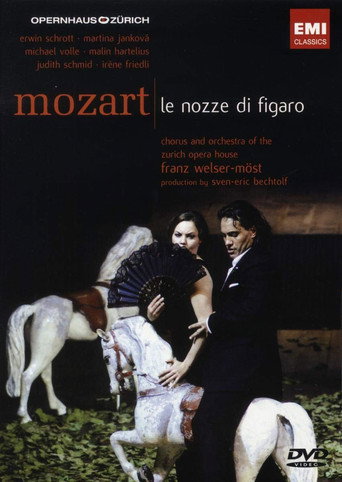 Mozart Le Nozze di Figaro · 2009
Mozart Le Nozze di Figaro
2009
MovieMusic
This is Schrott's second Figaro in a less than twelve month period, the earlier being the ROH production. The two productions have vast differences as well as similarities. The ROH production as been set in the equivalent of the Regency period--Spanish version. The Zurich is set in what appears to be the 1950's. For those who note such things, Schrott can appear sans shirt, but in an undershirt in the Zurich house. Vocally there is no difference between the two performances. The man has a glorious multi-hued voice over which he has complete command. Not only is he good looking he can act. He should have a great career. Indeed, the virile sound he produces would lead one to wonder if the great Verdi baritone roles are within his ability.
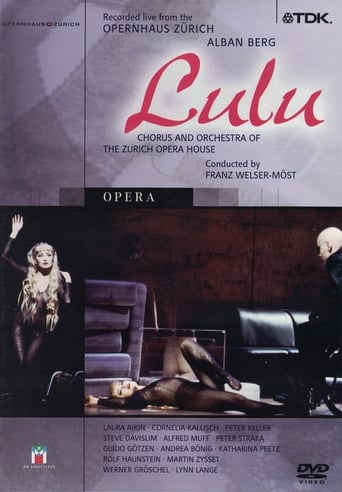 Berg: Lulu · 2004
Berg: Lulu
★ 6.02004
MovieMusic
Since its premiere on 2 June 1937 in Zurich, Alban Berg's second opera "Lulu" has the reputation of being surrounded by scandals. On the one hand, this is due to the dubious character of the subject, the man-eating femme fatale, which Berg had taken from Frank Wedekind's two Lulu tragedies – "The Earth Spirit" and "Pandora's Box" – and combined into one opera libretto. On the other hand, Berg's widow had (for personal reasons) repeatedly refused to have the opera completed, which was unfinished when Berg died. This video is of the unfinished two-act torso of "Lulu."
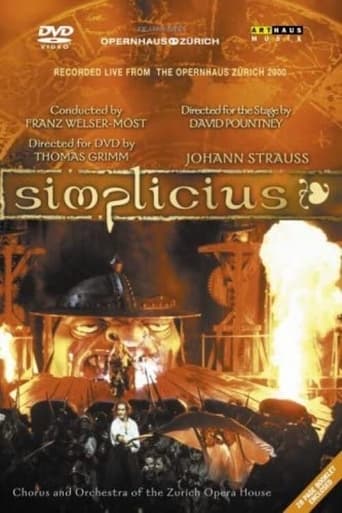 Johann Strauss: Simplicius · 2003
Johann Strauss: Simplicius
2003
Movie
Operetta in three acts / Sung in German Five years after Wagner's "Parsifal," Johann Strauss II presented "Simplicius" in the Theater an der Wien. Neither an opera nor an operetta, it was a work that did not fit into any of the pre-defined categories. On the 100th anniversary of the composer's death in 1999, the Zurich opera house presented a new production, the work's Swiss premiere. This production picked up on various impulses from the history of the works origin, using them to create a unique version of the piece. Here, for example, is the "Donauweibchen" incorporated shortly before the end. The Austrian-born chief conductor of the Zurich opera house, Franz Welser-Möst, has left his mark as a native speaker on this "Simplicius" production both here and elsewhere.
Filmography
Sort
Das Land des Lächelns - Opernhaus Zürich · 2017Das Land des Lächelns - Opernhaus Zürich
2017
MovieMusic
Tschang (Onkel von Sou-Chong)