C
Acting
Camille Ducharme
No biography available.
Known For
 A Man and His Sin · 1949
A Man and His Sin
★ 6.81949
MovieDrama
Filmed in French, this Canadian film was based on a popular Quebec-based radio serial. The man of the title is miserable miser Seraphim (Hector Charland). Misanthropic to the point of insanity, Seraphim takes great pleasure in destroying the lives of everyone with whom he comes in contact. His current target is Alexis (Guy Provost), the ex-lover of Seraphim's long-suffering wife Donalda (Nicole Germain). Taking into consideration its daytime-drama source, it's understandable that Un Homme et Son Peche is plotted and paced like a soap opera. Star Hector Charland had previously spent 10 years portraying Seraphim on radio, so he's got plenty of "mean" at his disposal for this big-screen spin-off.
 Séraphin · 1950
Séraphin
★ 8.01950
MovieDrama
In the summer of 1890, Curé Labelle pushed for colonization. To flee Séraphin and the woman he loved, Donalda, Alexis got married and settled on a piece of land. Everyone joins forces to take their revenge on the hateful Séraphin.
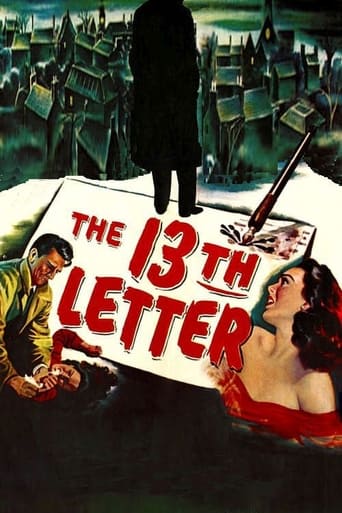 The 13th Letter · 1951
The 13th Letter
★ 5.71951
MovieCrimeMystery
A new doctor in a quiet Quebec town sparks rumors and accusations when anonymous letters allege an affair with a married woman.
 Troublemaker · 1964
Troublemaker
★ 8.01964
MovieDrama
A humanity student, Lucien is active in various extracurricular activities. Recognized by his peers, he represents other students in their challenge of college rules and the settlement of the fate of an incompetent professor. He ends up being thrown out of the school. After his mother's death, even though he dates Lise, a young woman with whom he does acting, he has to resist the advances of a homosexual whose death he will accidentally cause.
 Les indrogables · 1972
Les indrogables
1972
MovieComedy
 Twice Upon a Time · 1979
Twice Upon a Time
★ 10.01979
MovieComedy
This short satirical film takes us to Stereoville, a city where citizens must literally double up in their efforts to deal with the community’s 2 official languages. In Stereoville, each speaker of one language is tied to a speaker of the other, back-to-back. Into this two-stepping society stumbles a character whose very existence causes considerable consternation among locals: an unattached individual with command of both languages.
 L'esprit du mal · 1954
L'esprit du mal
★ 7.01954
MovieDrama
The story of a Machiavellian plan hatched by a money-grubbing stepmother to push aside the young lover of her stepdaughter whom she wants to marry a wealthy idiot. The woman devises the most abominable machinations to achieve her ends, going as far as to try and murder her own husband. This melodrama in which evil attempts to prevail over love was adapted from the play THE SPIRIT OF EVIL by Quebec’s prolific playwright of the 40s and 50s Henri Deyglun.
 Le curé de village · 1949
Le curé de village
★ 7.01949
MovieDrama
A convict on the run returns to his native village to see his daughter again, who believes him to be dead. The priest intervenes to avoid a scandal that would reflect on the young girl on the eve of getting married.