P
Sound
Pietro Mascagni
No biography available.
Known For
 The Three Tenors - Birth of a Legend · 2024
The Three Tenors - Birth of a Legend
★ 8.02024
MovieDocumentaryMusic
On the eve of the 1990 World Cup final, Plácido Domingo, José Carreras, and Luciano Pavarotti sang together for the first time. A look behind the scenes at a musical event whose phenomenal success lasted for more than a decade.
 Cavalleria rusticana / Pagliacci - Teatro alla Scala · 2011
Cavalleria rusticana / Pagliacci - Teatro alla Scala
★ 7.02011
MovieMusicTV Movie
The famos Double Feature of Verismo at La Scala with Daniel Harding conducting from February 2011
 Cavalleria Rusticana/Pagliacci · 1978
Cavalleria Rusticana/Pagliacci
★ 9.31978
Movie
Plácido Domingo accomplishes the rare feat of singing both leads on the same night at the Met in 1978 on opera's most popular double-bill.
 Cavalleria Rusticana / Pagliacci · 2015
Cavalleria Rusticana / Pagliacci
★ 6.52015
MovieMusic
As comparably short operas, Cavalleria Rusticana and Pagliacci are often billed together, but seldom is the lead tenor making his double role debut as Turiddu and Canio on the same evening. At the 2015 Salzburg Easter Festival, Jonas Kaufmann did just that to rapturous praise. Universally hailed as a coup for Kaufmann, the plaudits were also showered on Philipp Stölzl for his innovative staging which includes live video projections while referencing the era of black-and-white movies.
 Origins @ La Folle Journée de Nantes 2024 · 2024
Origins @ La Folle Journée de Nantes 2024
2024
MovieMusic
The grand closing concert of the 2024 edition of the Nantes classical music festival. The programme includes Dvorak's ‘Slavonic Dance’, Pablo de Sarasate's ‘Bohemian Airs’ and the first movement of Tchaikovsky's ‘Concerto for Piano and Orchestra No. 1’. Also excerpts from works by Chopin, Albéniz, Mascagni, Puccini and Sibelius.
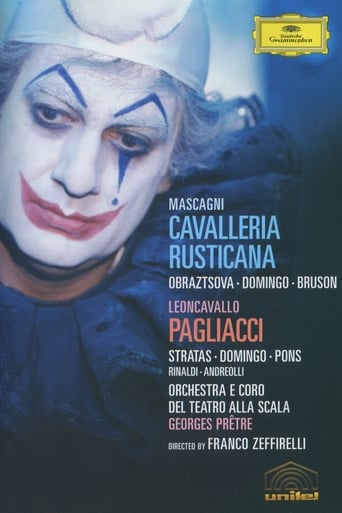 Cavalleria rusticana · 1982
Cavalleria rusticana
★ 7.71982
MovieTV MovieMusic
Franco Zeffirelli directs these two legendary La Scala productions telling tragic tales of jealousy. Mascagni's Cavalleria Rusticana features performances by Elena Obraztsova, Plácido Domingo, and Renato Bruson. Leoncavallo's I Pagliacci stars Teresa Stratas, Plácido Domingo, and Juan Pons. Both are conducted by George Pretre. This production of Pagliacci earned director Franco Zeffirelli the coveted Emmy as Best Director in the category of Classical Music Programming.
 Fatal Desire · 1954
Fatal Desire
★ 4.51954
MovieDramaMusic
In Pietro Mascagni's tragic opera, a soldier returns home from war to reclaim his former fiancée, only to find that she's married someone else in his absence, leading to jealousy, betrayal, and murder.
 Iris
Iris
MovieMusic
Following the runaway success of Cavalleria rusticana in 1890 at the age of 27, Mascagni did not rest on his laurels. In just a few years, he completed five operas, including Iris, premiered at the Teatro Costanzi in Rome in 1898. Mascagni might well have taken for his own Puccini's famous quip, “Against everything and everyone, make a work from melody”. And in Iris it is melodic invention which shows the composer's genius at its greatest. A melody by Mascagni is usually long, smooth and Italian-sounding; and Iris is full-on melody all the way, particularly in such crowd-pleasers as Jor's Serenade, the “Hymn of the Sun” or the duet in Act II “Oh come al tuo sottile corpo s'aggira”, which includes the famous “Piovra”. Furtheremore, with a little effort listeners can identify what would be the various musical “numbers”. In Iris, Mascagni is almost obsessively attentive to recitative and his exemplary flexibility at times recalls the sublime "conversation style" "invented" by Puccini.
Filmography
Sort