A
Directing
Aerlyn Weissman
No biography available.
Known For
 Forbidden Love: The Unashamed Stories of Lesbian Lives · 1992
Forbidden Love: The Unashamed Stories of Lesbian Lives
★ 6.81992
MovieDocumentaryHistory
Ten women in Canada talk about being lesbian in the 1940s, 1950s, and 1960s: discovering the pulp fiction of the day about women in love, their own first affairs, the pain of breaking up, frequenting gay bars, facing police raids, men's responses, and the etiquette of butch and femme roles. Interspersed among the interviews and archival footage are four dramatized chapters from a pulp novel, "Forbidden Love".
 No Way! Not Me · 1987
No Way! Not Me
1987
MovieDocumentary
In a stirring presentation, educator and rights activist Rosemary Brown warns that an impoverished future may face many young women unless they take control of their own lives. This film interweaves historical and contemporary sequences. Talking to an audience of male and female high school students, Brown emphasizes the need for male-female equality in the home and in the workplace.
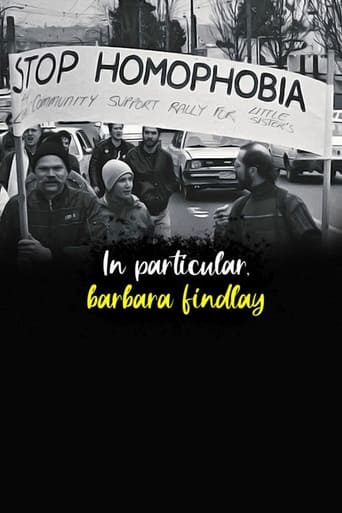 In Particular, Barbara Findlay · 2016
In Particular, Barbara Findlay
2016
MovieDocumentary
Over the last 30 years, barbara findlay has brought together the forces of feminism, anti-oppression and community activism, advocating for the rights and freedoms of queer and transgender Canadians.
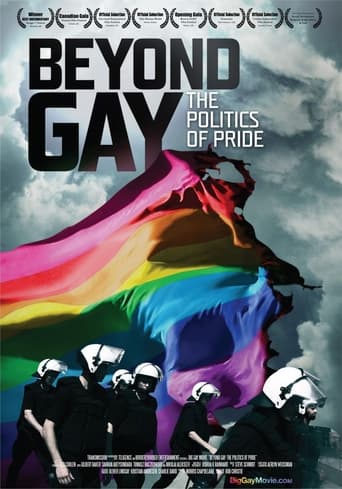 Beyond Gay: The Politics of Pride · 2010
Beyond Gay: The Politics of Pride
★ 3.92010
MovieDocumentaryHistory
Over the course of a year, film follows Vancouver Pride Society president Ken Coolen to various international Pride events, including Poland, Hungary, Russia, Sri Lanka and others where there is great opposition to pride parades. In North America, Pride is complicated by commercialization and a sense that the festivals are turning away from their political roots toward tourism, party promotion and entertainment. Christie documents the ways larger, more mainstream Pride events have supported the global Pride movement and how human rights components are being added to more established events. In the New York sequence, leaders organize an alternative Pride parade, the Drag March, set up to protest the corporatization of New York Pride. A parade in São Paulo, the world's largest Pride festival, itself includes a completely empty float, meant to symbolize all those lost to HIV and to anti-gay violence.
 Calling the Shots · 1988
Calling the Shots
★ 9.01988
MovieDocumentary
Documentary about women in the film industry. Numerous notable actresses and female directors share their thoughts.
 Strand, Under the Dark Cloth · 1989
Strand, Under the Dark Cloth
★ 6.61989
MovieDocumentary
This documentary studies the life and artwork of photographer Paul Strand, using his own compelling photography as well as interviews with his friends, acquaintances and third wife. Documentarian John Walker explores the various influences Strand encountered throughout his life that helped him to develop as an artist. His personal life and relationships are examined and shed light on the inner working of this man who achieved great renown while hiding "under the dark cloth."
 My Name Is Susan Yee · 1975
My Name Is Susan Yee
1975
MovieDocumentary
Young Chinese-Canadian Susan Yee gives a tour of Montreal.
 My Friends Call Me Tony · 1975
My Friends Call Me Tony
1975
MovieDocumentary
Meet Tony Rossi, a 10-year-old boy who can only distinguish light from shadow. Despite this difficulty, he leads a very active life. The short documentary shows the ingenious ways in which Tony manages his life. This film is part of the Children of Canada series.
Filmography
Sort